
Greek Fasolada - Traditional White Bean Soup
June 18, 2026
A Hearty, Tomato-Rich Greek White Bean Soup with Olive Oil, Herbs, and Mediterranean Warmth
A systems based approach to wellness and beauty
Vegan recipe - 100% plant-based. No meat, poultry, fish or sea life, no eggs, and no dairy or honey. Nothing that once was a living animal.
Caution - Allergen & Dietary Alerts
Please read before making, especially if cooking for others.
- No major allergens in the soup itself: The soup is free of the common allergen groups as written. Why: it is built from beans, vegetables, olive oil, and herbs.
- Optional bread on the side contains gluten: Crusty bread or toast is a serving suggestion only. Why: choose certified gluten-free bread, or skip it, for gluten sensitivity or celiac disease.
- Vegan, gluten-free, nut-free, and soy-free as written.
Always check individual product labels, as ingredients and "may contain" warnings vary by brand.
Author, Editorial Note & Disclosure
The author brings over two decades of professional experience across biotechnology and pharmaceutical organizations, together with a long-standing passion for mindful nutrition, holistic wellness, and preventive health.
This recipe is intended for informational and educational purposes only. Nutritional estimates, where provided, are approximate and may vary based on specific ingredients, brands, and preparation methods used.
Jump To
About This Recipe
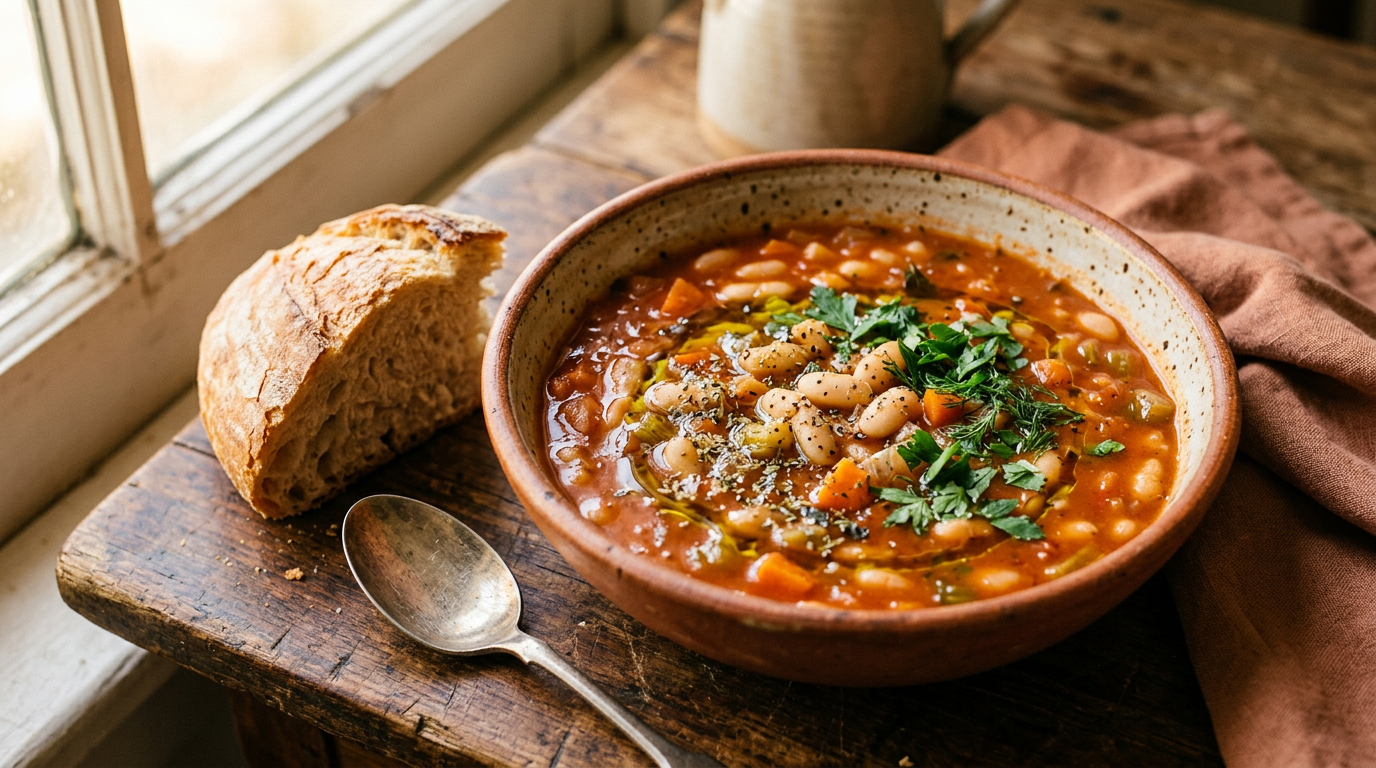
Fasolada (pronounced fah-so-LAH-tha) is one of Greece's most beloved home-style soups. The word comes from fasolia, meaning beans - and if you need a Western shorthand, think of it as a Greek white bean and vegetable soup: simple, hearty, tomato-rich, and finished generously with extra virgin olive oil. For Greek households, this is not a restaurant dish. It is practical, everyday cooking at its most honest.
The familiar version many people recognize today - tomato, olive oil, carrots, celery, onion, and herbs - is a relatively modern one, since tomatoes arrived in the Mediterranean after the Columbian exchange. But the tradition of legume soups in the region is ancient. Greek culinary folklore even connects bean soup to Theseus, who, on his return from Crete, is said to have cooked leftover legumes from the ship as an offering. It is a lovely story, and it tells you something real: beans have been woven into Greek food culture for a very long time.
This Hanuvier version is faithful to that spirit - dry white beans soaked overnight, a slow-simmered soup base built on sauteed onion, carrot, celery, garlic, and tomato, and a finishing pour of good olive oil with fresh lemon and herbs. Nothing complicated. Nothing unnecessary. Just a bowl that earns its place on the table.
At a Glance
Prep Time: 20 minutes active (plus 8-12 hours overnight soaking)
Cook Time: 1 hour 30 minutes
Total Time: About 1 hour 50 minutes active, plus overnight
Servings: 6
Difficulty: Medium
Dietary Tags: Vegan, Gluten-Free, Nut-Free, Soy-Free
Ingredients
Beans and Soaking
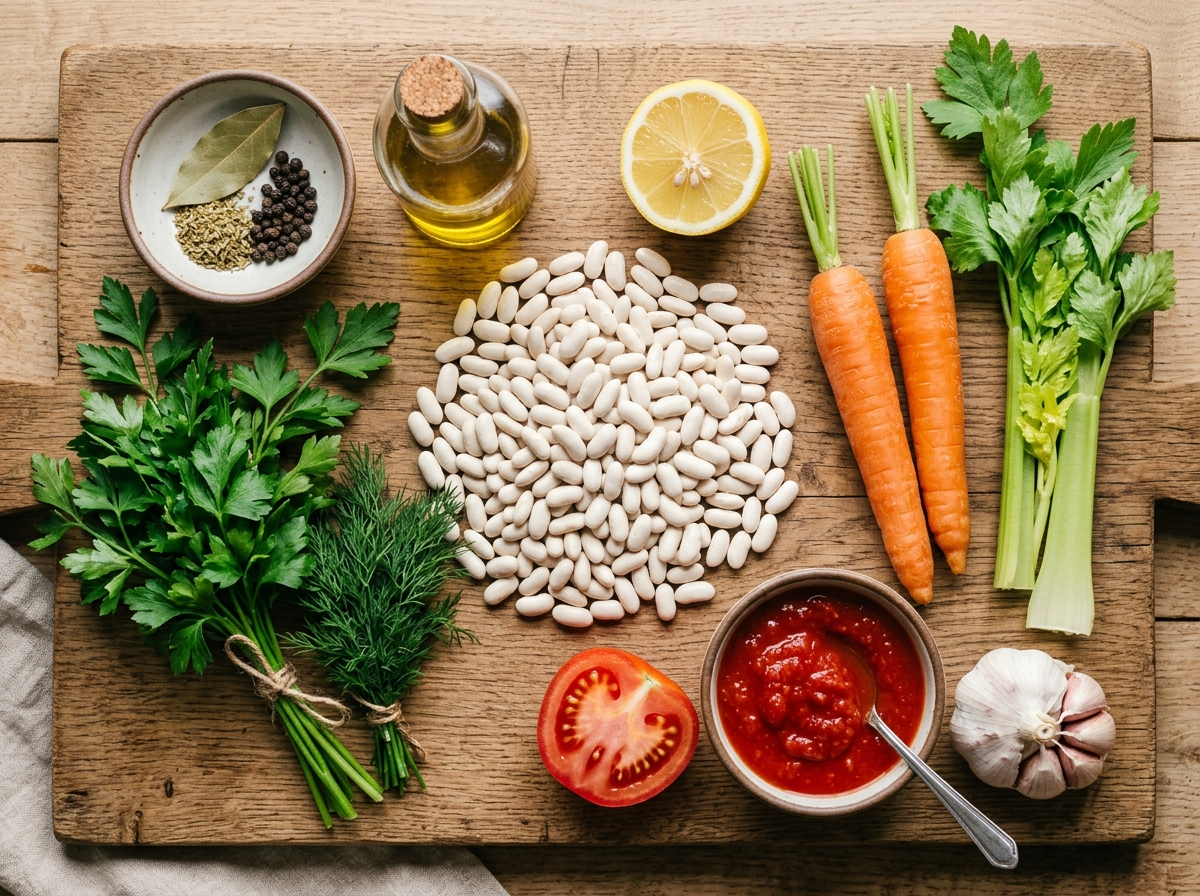
- 1 1/2 cups dry white beans, such as cannellini, great northern, or navy beans (about 300g)
- 6 cups cold water, for soaking overnight
- 6 cups fresh water, for the first bean simmer
- 1/2 tsp sea salt, for the first bean simmer
Soup Base
- 3 tbsp extra virgin olive oil
- 1 cup finely diced yellow onion (about 1 medium onion)
- 1 cup diced carrot, cut into 1/4-inch pieces (about 2 medium carrots)
- 3/4 cup diced celery, cut into 1/4-inch pieces (about 2 medium stalks)
- 2 tsp finely grated fresh garlic
- 2 tbsp tomato paste
- 1 cup crushed tomatoes, canned or fresh
- 5 cups low-sodium vegetable broth or water
- 1 dried bay leaf
- 1 tsp dried Greek oregano, or regular dried oregano
- 1/2 tsp sweet paprika
- 1/4 tsp freshly ground black pepper
- 3/4 tsp sea salt
Finishing
- 2 tbsp extra virgin olive oil (for finishing)
- 2 tbsp fresh lemon juice
- 1/4 cup finely chopped fresh flat-leaf parsley
- 2 tbsp finely chopped fresh dill (optional but recommended)
- 1/8 tsp sea salt, only if needed after tasting
Optional Serving Additions
- 1 tsp extra virgin olive oil per bowl
- 1 tsp fresh lemon juice per bowl
- 1 tbsp chopped fresh parsley or dill per bowl
- Warm crusty bread or whole-grain toast
- Olives or a simple cucumber-tomato salad on the side
Instructions
- Measure 1 1/2 cups dry white beans and spread them on a clean plate or tray. Pick through carefully and remove any small stones, broken beans, or discolored pieces. Transfer to a fine-mesh strainer and rinse under cold running water for 45-60 seconds.
- Place the rinsed beans in a large bowl and add 6 cups cold water - the beans should be covered by at least 2 inches, as they will expand significantly. Cover and soak at room temperature for 8-12 hours or overnight. After soaking, drain and rinse again under cold water.
- Quick-soak option: If you forgot to soak overnight, place the rinsed beans in a large pot with 6 cups water. Bring to a boil over medium-high heat and boil for 2 minutes. Turn off the heat, cover, and let sit for 1 hour. Drain and rinse before continuing.
- Place the soaked, rinsed beans in a large soup pot. Add 6 cups fresh water and 1/2 tsp sea salt. Bring to a boil over medium-high heat, then reduce to low and simmer uncovered for 35-45 minutes. At 35 minutes, taste 2 beans - they should be partly tender but not fully creamy yet. Drain and set the beans aside.
- While the beans simmer, prepare the vegetables. Finely dice the onion to get 1 cup. Peel and dice the carrots into 1/4-inch pieces to get 1 cup. Dice the celery into 1/4-inch pieces to get 3/4 cup. Finely grate the garlic to measure 2 tsp. Measure out the tomato paste and crushed tomatoes so they are ready to add.
- Place the empty soup pot over medium heat and add 3 tbsp extra virgin olive oil. Add the diced onion, carrot, and celery. Cook for 7-8 minutes, stirring every minute, until the onion is translucent and the vegetables begin to soften. Do not brown them deeply - fasolada should taste gently savory rather than roasted.
- Add 2 tsp grated fresh garlic and stir for 30 seconds until fragrant. Add 2 tbsp tomato paste and stir continuously for 1 minute so it lightly darkens and coats the vegetables, which deepens the tomato flavor.
- Add 1 cup crushed tomatoes and stir for 30 seconds. Add the partially cooked beans, 5 cups vegetable broth or water, 1 dried bay leaf, 1 tsp dried oregano, 1/2 tsp sweet paprika, 1/4 tsp black pepper, and 3/4 tsp sea salt. Stir gently to combine.
- Bring the soup to a gentle boil over medium-high heat. Once boiling, reduce the heat to low. Partially cover the pot, leaving a small gap for steam to escape. Simmer for 35-45 minutes, stirring every 10 minutes. The soup is ready when the beans are tender and creamy inside, the carrots are soft, and the broth is lightly thickened. If it becomes too thick before the beans are done, stir in 1/2 cup water and continue simmering.
- When the beans are fully tender, remove 1/2 cup of beans and broth and mash them with a fork until mostly smooth. Return the mash to the pot and stir - this thickens the soup naturally without cream or flour.
- Turn off the heat and remove the bay leaf. Stir in 2 tbsp extra virgin olive oil, 2 tbsp fresh lemon juice, 1/4 cup chopped parsley, and 2 tbsp chopped dill if using. Let the soup rest uncovered for 5 minutes. Taste and adjust: add 1/8 tsp sea salt if it tastes flat, or 1 tsp extra lemon juice if it needs more brightness.
- Ladle into bowls and finish each with 1 tsp extra virgin olive oil, 1 tsp fresh lemon juice if desired, and a tablespoon of chopped parsley or dill. Serve with warm crusty bread, olives, or a simple side salad.
Chef's Tips
- Don't skip the two-stage cooking - simmering the beans separately first helps them cook more evenly and keeps the soup broth cleaner and more refined in flavor.
- The finishing olive oil matters. Use your best extra virgin olive oil here, added off the heat, so its flavor stays fresh and grassy rather than cooking away.
- Storage: refrigerate in an airtight container for up to 4 days. The soup thickens as it rests - add 1/4 to 1/2 cup water while reheating gently over medium-low heat for 6-8 minutes. Refresh each serving with 1 tsp lemon juice and 1 tsp olive oil.
- Freeze leftovers for up to 2 months. Thaw overnight in the refrigerator before reheating on the stovetop.
- To make it more substantial, stir in a handful of baby spinach or kale during the last 5 minutes of simmering, or serve with warm crusty bread and a simple side salad to round out the meal.
Nutritional Information
Approximate values per serving, based on 6 servings. Actual values will vary depending on bean variety, olive oil measurement, vegetable sizes, and broth choice.
- Calories: 280-320
- Protein: 12-14 g
- Fiber: 9-11 g
- Fat: 10-13 g (predominantly monounsaturated from olive oil)
- Carbohydrates: 36-42 g
- Iron: approximately 20-25% of daily value
- Folate: approximately 30-35% of daily value
- Key Nutrients Present: Protein, fiber, iron, folate, magnesium, potassium, and vitamin A.
Nutrition values are approximate and may vary depending on ingredient brands, preparation method, and serving size.
Wellness Connection
Fasolada is not a single-ingredient wellness recipe. Its value is in the combination: white beans for plant-based protein, fiber, iron, magnesium, folate, and potassium; carrots, celery, onion, tomato, and herbs for plant diversity and natural flavor; extra virgin olive oil for monounsaturated fats and the richness that makes the soup feel satisfying rather than austere; and the broth itself, which adds warmth and hydration. None of these elements does the work alone. They work together, which is exactly the kind of interconnected approach Hanuvier applies to wellness.
If you're building a broader daily wellness routine alongside meals like this one, this soup pairs naturally with Hanuvier's Plant Protein & Collagen Booster, which integrates plant protein with collagen-supporting nutrients in a single daily serving - complementing the foundational plant nutrition already present in a bowl of fasolada.
Frequently Asked Questions
Can I use canned white beans instead of dried?
Yes. Use 3 cans (about 1360g / 48 oz total) of canned white beans, drained and rinsed. Skip the soaking and first simmer steps and go straight to sauteing the vegetables. Reduce the soup simmer time to 20-25 minutes, since canned beans are already fully cooked and just need to absorb the flavors of the broth.
What type of white bean works best?
Cannellini beans are the traditional Greek choice - their creamy texture and mild flavor are ideal here. Great northern beans are a close second. Navy beans work well too and cook a little faster. All three produce excellent fasolada; the differences in texture are subtle.
How do I store and reheat leftovers?
Refrigerate in an airtight container for up to 4 days. The soup will thicken as it rests - add 1/4 to 1/2 cup water when reheating gently on the stovetop. Refresh each bowl with 1 tsp lemon juice and 1 tsp olive oil before serving. Fasolada also freezes well for up to 2 months; thaw overnight in the fridge before reheating.
Is there an oil-free version?
You can saute the vegetables in 1/4 cup water or low-sodium vegetable broth instead of olive oil, adding a splash at a time to prevent sticking. Omit the finishing olive oil and add an extra tablespoon of fresh lemon juice for brightness. The soup will be lighter in flavor and body, but still very good.
Can I add other vegetables?
Yes. Diced zucchini, diced potato, or a handful of baby spinach or kale all work well. Add them during the last 15-20 minutes of simmering (potatoes) or the last 5 minutes (zucchini, spinach, kale) so they do not overcook and turn mushy.
What is Hanuvier's systems-based approach to wellness and beauty?
The body functions as an interconnected system, with nutrients participating in multiple biological processes and often working alongside one another. Hanuvier uses this systems perspective to develop thoughtfully formulated products that support wellness, beauty, or both through a holistic approach rather than a single-ingredient focus.
Related Recipes & Articles
Make it a daily habit
Five collagen boosters and 20g of organic plant protein, every dose on the label.*
See what's inside HanuvierFree U.S. shipping · 60-day money-back guarantee · 10% off your first order
