
Muhammara
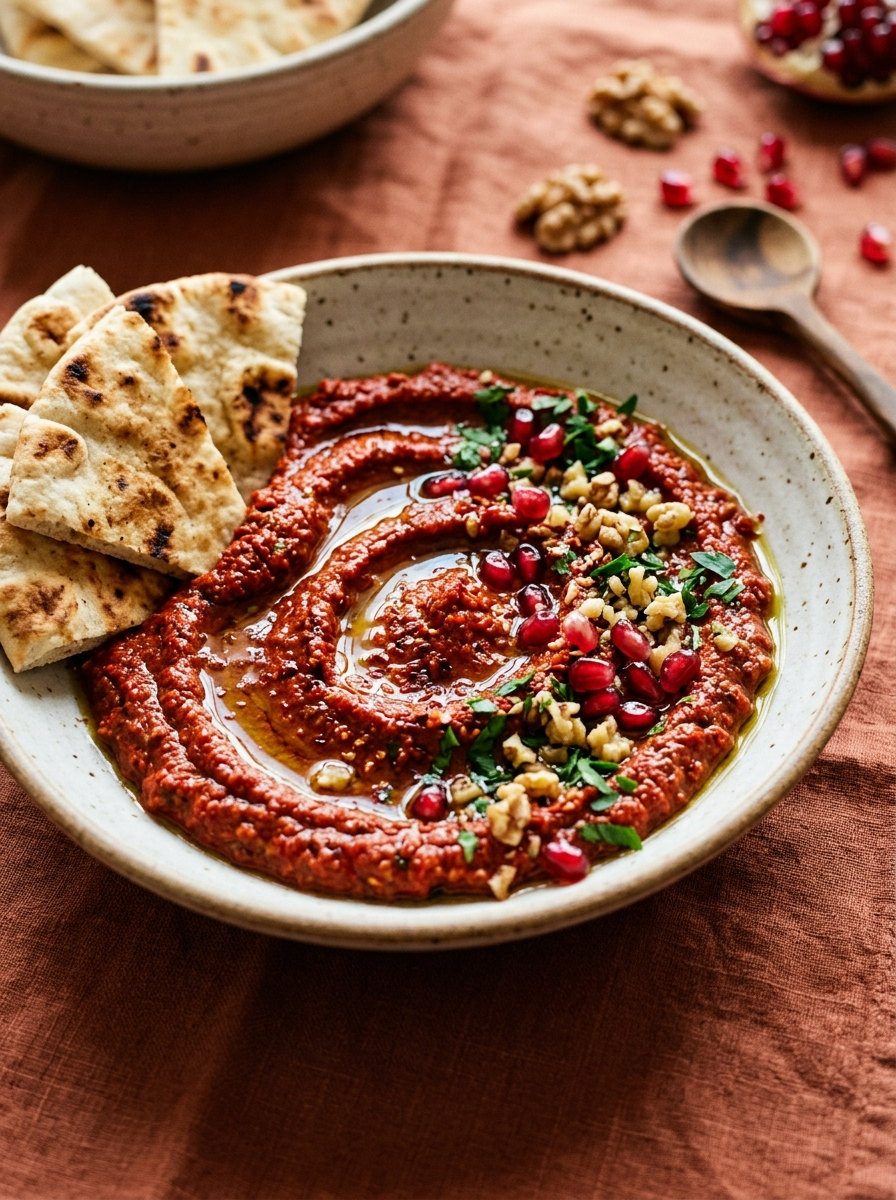
A rich Syrian roasted red pepper dip with walnuts, pomegranate molasses, and Aleppo pepper - smoky, tangy, and deeply satisfying
A systems based approach to wellness and beauty
Vegan recipe - 100% plant-based. No meat, poultry, fish or sea life, no eggs, and no dairy or honey.
Caution - Allergen & Dietary Alerts
Please read before making, especially if cooking for others.
- Tree nuts (walnuts): walnuts are the structural foundation of this dip and cannot be omitted. Why: tree nuts are a major allergen. This recipe is not suitable for anyone with a tree nut or walnut allergy.
- Gluten (breadcrumbs): the recipe uses whole-wheat or plain breadcrumbs. Why: standard breadcrumbs contain gluten. For a gluten-free version, use certified gluten-free breadcrumbs - the dip works equally well with either.
- Gluten-free option available: swap standard breadcrumbs for certified gluten-free breadcrumbs. All other ingredients are naturally gluten-free.
- Nightshade vegetables: this recipe contains roasted red bell peppers. Why: some individuals avoid nightshades. Bell peppers are the primary flavor base and cannot be omitted.
- Vegan and Dairy-Free and Egg-Free as written - no animal products of any kind.
- Soy-free as written - no soy-containing ingredients used.
Gluten-free option: use certified gluten-free breadcrumbs. Always check individual product labels, as ingredients and "may contain" warnings vary by brand.
Author, Editorial Note & Disclosure
The author brings over two decades of professional experience across biotechnology and pharmaceutical organizations, together with a long-standing passion for mindful nutrition, holistic wellness, and preventive health.
This recipe is intended for informational and educational purposes only. Nutritional estimates, where provided, are approximate and may vary based on specific ingredients, brands, and preparation methods used.
Jump To
About This Recipe
Muhammara is a roasted red pepper and walnut dip associated especially with Aleppo, a city in northern Syria that has given the world some of its most distinctive ingredients - not least the mild, fruity dried chili that bears its name. The word muhammara comes from the Arabic for "reddened," a name that captures both the color and the spirit of the dish: deep, warm, and unmistakably Levantine. Across Syria and the broader Eastern Mediterranean, it appears as part of mezze - the tradition of small shared plates that turns a meal into a conversation.
What makes muhammara distinctive is the meeting of contrasts. Roasted red peppers bring sweetness and smoke. Walnuts bring richness and a pleasantly bitter edge. Pomegranate molasses - a thick, tangy-sweet syrup made from reduced pomegranate juice - pulls everything into balance with a bright, tart depth that you cannot quite achieve with lemon juice alone. Breadcrumbs absorb the moisture and give the dip its thick, spreadable body. Cumin and Aleppo pepper add warmth without sharpness. The result is savory, nutty, gently tangy, lightly smoky, and entirely its own thing.
This Hanuvier version is designed for the Western home kitchen: straightforward to make with either fresh roasted peppers or good-quality jarred ones, and flexible enough to work as a vegan dip for pita and vegetables, a roasted red pepper spread for grain bowls and wraps, or the centerpiece of a mezze platter. For an added protein boost alongside serving, pair it with a portion of Hanuvier's Plant Protein & Collagen Booster.
At a Glance
Prep Time: 15 minutes
Cook Time: 20 minutes (if roasting peppers at home; 0 minutes if using jarred)
Total Time: 35 minutes
Servings: 6 small servings as part of mezze
Difficulty: Easy
Dietary Tags: Vegan, Dairy-Free, Egg-Free, Soy-Free. Caution: contains tree nuts (walnuts) and gluten (breadcrumbs). Gluten-free option available - see Allergen Alerts above.
Ingredients
For the Muhammara
- 2 large red bell peppers, roasted and peeled - or 1 cup drained jarred roasted red peppers
- 1 cup walnut halves, toasted
- 1/2 cup whole-wheat breadcrumbs or plain breadcrumbs (use certified gluten-free for a GF version)
- 2 tbsp extra-virgin olive oil, plus 1 tsp for serving
- 1 1/2 tbsp pomegranate molasses
- 1 tbsp fresh lemon juice
- 1 tsp finely minced fresh garlic (about 1 medium clove)
- 1 tsp ground cumin
- 1/2 tsp Aleppo pepper - or smoked paprika if Aleppo pepper is unavailable (see FAQ)
- 1/4 tsp fine sea salt
- 1/8 tsp freshly ground black pepper
- 1 to 2 tbsp cold water, only if needed to adjust consistency
Optional Garnish
- 1 tsp extra-virgin olive oil
- 1 tbsp finely chopped walnuts
- 1 tsp pomegranate seeds
- 1 small pinch Aleppo pepper or smoked paprika
- 1 tbsp flat-leaf parsley, finely chopped
Serving Suggestions
- Warm pita wedges
- Cucumber slices and carrot sticks
- Whole-grain crackers
- As a spread in vegetable wraps or grain bowls
- As part of a vegan mezze platter with hummus, olives, and tabbouleh
Instructions
- If roasting peppers at home: preheat the oven to 450 degrees F (230 degrees C). Place 2 large red bell peppers on a parchment-lined baking sheet. Roast for 18-22 minutes, turning once halfway through, until the skins are blistered and darkened in spots. If using jarred roasted red peppers, drain them well and skip to Step 3.
- Steam and peel the roasted peppers: transfer the hot roasted peppers to a bowl and cover tightly with a plate or clean kitchen towel. Let them steam for 10 minutes - this loosens the skins. Peel off the loosened skins with your fingers, remove the stems and seeds, and pat the peppers completely dry with a kitchen towel. Any residual water will make the dip watery.
- Toast the walnuts: place 1 cup walnut halves in a dry skillet over medium-low heat. Toast for 4-5 minutes, stirring often, until fragrant and slightly deeper in color. Transfer to a plate and let cool for 5 minutes. Do not leave them in the hot pan - carry-over heat can make them taste bitter.
- Load the food processor: add the roasted peppers, toasted walnuts, 1/2 cup breadcrumbs, 2 tbsp olive oil, 1 1/2 tbsp pomegranate molasses, 1 tbsp lemon juice, 1 tsp minced garlic, 1 tsp cumin, 1/2 tsp Aleppo pepper (or smoked paprika), 1/4 tsp salt, and 1/8 tsp black pepper to a food processor.
- Pulse for texture - do not over-blend: pulse 8-10 times, scraping down the sides once or twice, until the dip becomes thick and spreadable with a slightly rustic, textured finish. Muhammara is best when it still has a little character from the walnuts and breadcrumbs - not a completely smooth paste.
- Adjust consistency if needed: if the dip is too thick, add 1 tbsp cold water and pulse 2-3 more times. Add a second tablespoon only if needed. If the dip is too loose, add 1 tbsp breadcrumbs, pulse again, and rest for 5 minutes - breadcrumbs continue to absorb moisture as the dip sits.
- Taste and balance: taste the muhammara carefully. Adjust as needed - add 1 tsp lemon juice for more brightness; add 1/2 tsp pomegranate molasses for more tangy-sweet depth; add a small pinch of salt if the flavor tastes flat. The finished flavor should be savory, nutty, gently tangy, and lightly sweet, with warm background heat from the cumin and pepper.
- Rest before serving: transfer the dip to a serving bowl and let it rest at room temperature for 10 minutes. This allows the walnuts, breadcrumbs, peppers, and spices to settle together and the flavor to deepen.
- Garnish and serve: use the back of a spoon to make a shallow swirl on top of the dip. Drizzle with 1 tsp olive oil. Scatter chopped walnuts, pomegranate seeds, parsley, and a small pinch of Aleppo pepper or smoked paprika over the top. Serve at room temperature with warm pita, vegetables, crackers, or as part of a mezze spread.
Chef's Tips
- Jarred peppers are a genuine shortcut. Good-quality jarred roasted red peppers work just as well as home-roasted ones. Drain them thoroughly and pat them dry - excess liquid is the main enemy of a thick, well-textured muhammara. Look for peppers packed in water or a light brine, not in heavy oil.
- Pulse, don't blend. The texture of muhammara is part of its identity. Use the pulse function on your food processor and stop when the dip is thick and slightly rustic. A completely smooth paste loses the pleasant nuttiness and body that make this dip satisfying. Eight to ten pulses is usually enough.
- Toast the walnuts - do not skip this step. Raw walnuts have a slightly astringent, bitter edge. Toasting brings out their natural oils and gives muhammara its characteristic depth. Four to five minutes in a dry pan over medium-low heat is all it takes.
- Pomegranate molasses is the non-negotiable ingredient. It gives muhammara its distinctive sweet-tart depth that no combination of lemon juice and sugar can fully replicate. It is available at Middle Eastern grocery stores, specialty food shops, and online. If truly unavailable, see the FAQ below for a substitute - but try to find it first.
- Muhammara keeps and improves. Store in an airtight container in the refrigerator for up to 4 days. The flavor deepens overnight. Before serving from the fridge, let it come to room temperature for 15 minutes and refresh with a small drizzle of olive oil and a stir.
Nutritional Information
Approximate values per small serving, based on 6 servings. Values will vary depending on pepper size, walnut brand, breadcrumb type, olive oil measurement, and whether optional garnishes are included.
- Calories: approximately 160-210 kcal
- Protein: approximately 4-6 g
- Carbohydrates: approximately 10-14 g
- Fat: approximately 12-16 g
- Fiber: approximately 3-5 g
- Key Nutrients Present: Protein, fiber, vitamin C, magnesium, potassium, healthy fats (from walnuts and olive oil).
Nutrition values are approximate and may vary depending on ingredient brands, preparation method, and serving size.
Wellness Connection
Muhammara earns its place in the Hanuvier recipe collection not because of any single functional claim, but because of what it is as a whole: a plant-based dip built from whole-food ingredients - roasted peppers, toasted walnuts, olive oil, spices, and pomegranate molasses - that delivers flavor, texture, and nutritional value together. Walnuts are one of the most nutritionally complete nuts available, contributing plant-based fat, modest protein, and magnesium in a small serving. Roasted red peppers are among the most concentrated sources of vitamin C in the vegetable world. Olive oil carries fat-soluble flavor compounds from the garlic and spices into every mouthful.
At Hanuvier, the systems-based approach to wellness means looking at what a meal contributes as a whole rather than isolating a single ingredient. This plant-based dip reflects that thinking: nothing here is doing one job. The walnuts provide richness and structure. The peppers provide sweetness and color. The pomegranate molasses brightens and balances. The breadcrumbs create body. Everything works together - and the result is a vegan mezze dip that is genuinely satisfying rather than a compromise.
Frequently Asked Questions
What is muhammara?
Muhammara is a roasted red pepper and walnut dip from the Levant, associated especially with Aleppo in northern Syria. The name comes from the Arabic word for "reddened," reflecting its deep crimson color. It is traditionally served as part of mezze - the Eastern Mediterranean tradition of shared small plates - alongside pita, olives, and other dips. The key flavor notes are savory, nutty, lightly sweet, and tangy, with warmth from cumin and mild chili.
What is Aleppo pepper, and what is the best Aleppo pepper substitute?
Aleppo pepper is a mild, fruity dried chili associated with the region around Aleppo, Syria. It has a moderate heat level, a slightly oily texture from its natural oils, and a flavor that is more fruity and complex than most dried chilies. The best Aleppo pepper substitute for this recipe is smoked paprika - it gives similar color and a gentle warmth without the fruity complexity, but works very well in muhammara. A 1:1 substitution by volume is the right approach. Aleppo pepper is available at Middle Eastern grocery stores and online.
What is pomegranate molasses, and is there a substitute?
Pomegranate molasses is a thick, dark, tangy-sweet syrup made by reducing pomegranate juice until it becomes concentrated and syrupy. It is used widely across Levantine, Persian, and Turkish cooking. For this recipe it provides the signature sweet-tart depth that makes muhammara distinctive. It is available at Middle Eastern grocery stores, specialty food shops, and online. If genuinely unavailable, the closest substitute is 1 tbsp of tamarind paste mixed with 1/2 tsp maple syrup - this approximates the sour-sweet balance. Plain lemon juice alone is not an adequate substitute as it lacks sweetness and depth.
How is muhammara different from hummus?
Muhammara and hummus are both Levantine dips served as part of mezze, but they are made from completely different ingredients and have very different flavor profiles. Hummus is made from chickpeas, tahini, lemon, and garlic - it is mild, creamy, and earthy. Muhammara is made from roasted red peppers, walnuts, and pomegranate molasses - it is richer, smokier, tangier, and has a deeper, more complex flavor. They complement each other beautifully on a mezze platter precisely because they are so different.
Can I make muhammara without a food processor?
Yes, with some effort. Finely chop the toasted walnuts and roasted peppers by hand, as small as you can manage. Mash them together in a bowl with a fork, then stir in the breadcrumbs, olive oil, pomegranate molasses, lemon juice, garlic, and spices. The texture will be more rustic and chunky than a food processor version, but that is not a problem - a hand-made muhammara has a pleasant, coarse texture that many people prefer.
What is Hanuvier's systems-based approach to wellness and beauty?
The body functions as an interconnected system, with nutrients participating in multiple biological processes and often working alongside one another. Hanuvier uses this systems perspective to develop thoughtfully formulated products that support wellness, beauty, or both through a holistic approach rather than a single-ingredient focus.
Related Recipes & Articles
More plant-based recipes from the Hanuvier Wellness Hub
- Mujadara - Levantine Lentils and Rice
- Quinoa Solterito - Andean Salad Bowl
- Ratatouille - Provencal Vegetable Stew
From the Hanuvier Wellness Hub
Make it a daily habit
Five collagen boosters and 20g of organic plant protein, every dose on the label.*
See what's inside HanuvierFree U.S. shipping · 60-day money-back guarantee · 10% off your first order
