
Tuscan Ribollita
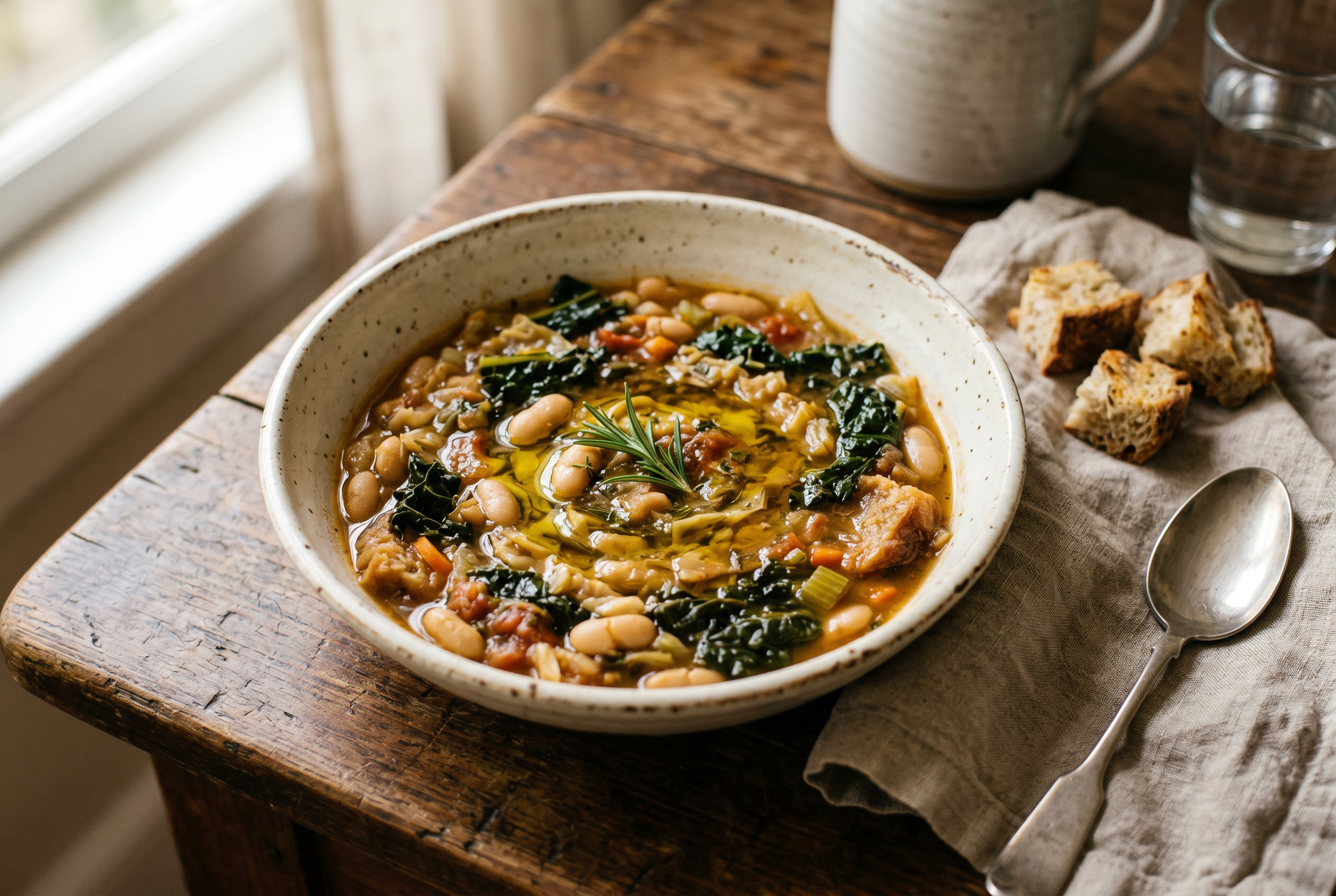
A rustic Tuscan soup of cannellini beans, Tuscan kale, and bread - slow-simmered comfort in a bowl
A systems based approach to wellness and beauty
Vegan recipe - 100% plant-based. No meat, poultry, fish or sea life, no eggs, and no dairy or honey. Nothing that once was a living animal.
Caution - Allergen & Dietary Alerts
Please read before making, especially if cooking for others.
- Contains gluten (bread): Rustic bread is used to thicken the soup. Why: wheat bread contains gluten; use a sturdy gluten-free loaf, or omit the bread and add extra mashed beans (see Chef's Tips), for gluten sensitivity or celiac disease.
- Naturally nut-free, soy-free, and dairy-free as written. Why: this version uses no cheese, unlike some traditional recipes.
- Vegan as written - no meat, poultry, fish, sea life, eggs, dairy, or honey.
Always check individual product labels, as ingredients and "may contain" warnings vary by brand.
Author, Editorial Note & Disclosure
The author brings over two decades of professional experience across biotechnology and pharmaceutical organizations, together with a long-standing passion for mindful nutrition, holistic wellness, and preventive health.
This recipe is intended for informational and educational purposes only. Nutritional estimates, where provided, are approximate and may vary based on specific ingredients, brands, and preparation methods used.
Jump To
About This Recipe
Ribollita is one of Tuscany's most beloved examples of cucina povera - the Italian tradition of resourceful cooking that turns simple, affordable ingredients into deeply satisfying meals. Its name means "re-boiled," and it tells you exactly how the dish was born.
Traditionally, a humble pot of vegetable and white bean soup would be stretched with yesterday's stale bread, then gently reheated the next day. That second cooking is the secret: it makes the soup thicker, rounder, and more comforting than it ever was the day before.
This was never luxury food. It was practical food - cannellini beans, seasonal vegetables, dark leafy greens, good olive oil, and bread that would otherwise have gone to waste. Yet over generations, ribollita became one of Tuscany's most iconic dishes precisely because it captures something timeless: nourishment, thrift, patience, and flavor. Its story is not royal but communal, belonging to farmers, families, and the shared Tuscan table, where meals are about seasonality, memory, and respect for what the land provides.
For Hanuvier, ribollita is a perfect recipe because it shows that wellness does not have to be complicated. Sometimes the most enduring, nourishing foods are built from beans, greens, vegetables, olive oil, and a little time.
At a Glance
Prep Time: 25 minutes
Cook Time: 50 minutes
Total Time: 1 hour 15 minutes (plus optional overnight rest)
Servings: 6
Difficulty: Easy
Dietary Tags: Vegan, Dairy-Free, Nut-Free, Soy-Free (contains gluten from the bread; gluten-free option in Chef's Tips)
Ingredients
This version uses canned cannellini beans - creamy Italian white beans - for everyday accessibility. To use dried beans, see the note at the end.
Soup Base
- 3 tbsp extra-virgin olive oil, plus 1 tsp per bowl for serving if desired
- 1 cup yellow onion, finely diced (about 5 oz)
- 3/4 cup carrot, finely diced (about 4 oz)
- 3/4 cup celery, finely diced (about 3 oz)
- 2 tsp fresh garlic, finely grated
- 2 tbsp tomato paste
- 1 cup crushed tomatoes, canned (no salt added if available)
- 6 cups low-sodium vegetable broth or water
- 1 tsp sea salt, plus 1/8 tsp more only if needed at the end
- 1/2 tsp freshly ground black pepper
- 1 tsp dried thyme
- 1 tsp fresh rosemary, finely chopped (or 1/2 tsp dried rosemary)
- 1 bay leaf
Beans, Greens & Vegetables
- 3 cups cooked cannellini beans, drained and rinsed (from two 15-oz cans)
- 2 cups lacinato kale (Tuscan kale / cavolo nero), stems removed, leaves sliced into 1/2-inch ribbons
- 2 cups green cabbage, thinly sliced into 1/2-inch strips
- 1 cup potato, peeled and cut into 1/2-inch cubes (about 5 oz)
- 1 cup zucchini, cut into 1/2-inch cubes (about 5 oz)
Bread Thickener
- 3 cups stale rustic bread, cut into 1-inch cubes (about 4 oz)
- If the bread is fresh, dry it in a 325 F (160 C) oven for 10 to 12 minutes until firm but not browned
Optional Finishing
- 1 tbsp fresh parsley, finely chopped
- 1 tsp extra-virgin olive oil per serving
- 1/8 tsp red pepper flakes, for mild heat
- 1 tsp fresh lemon juice per bowl, for brightness (optional, not traditional)
Instructions
- Wash all vegetables under cold running water and pat them dry with a clean towel.
- Finely dice the onion into roughly 1/4-inch pieces to measure 1 cup.
- Finely dice the carrot to measure 3/4 cup and the celery to measure 3/4 cup.
- Finely grate the fresh garlic to measure 2 teaspoons.
- Dice the potato and zucchini into 1/2-inch cubes, measuring 1 cup of each and keeping the pieces even so they cook at the same rate.
- Remove the kale stems and slice the leaves into 1/2-inch ribbons (2 cups), then thinly slice the cabbage into 1/2-inch strips (2 cups).
- Drain and rinse the cannellini beans, then measure 3 cups. Mash 1 cup with a fork until mostly creamy and keep the remaining 2 cups whole - the mashed beans thicken the soup without any cream.
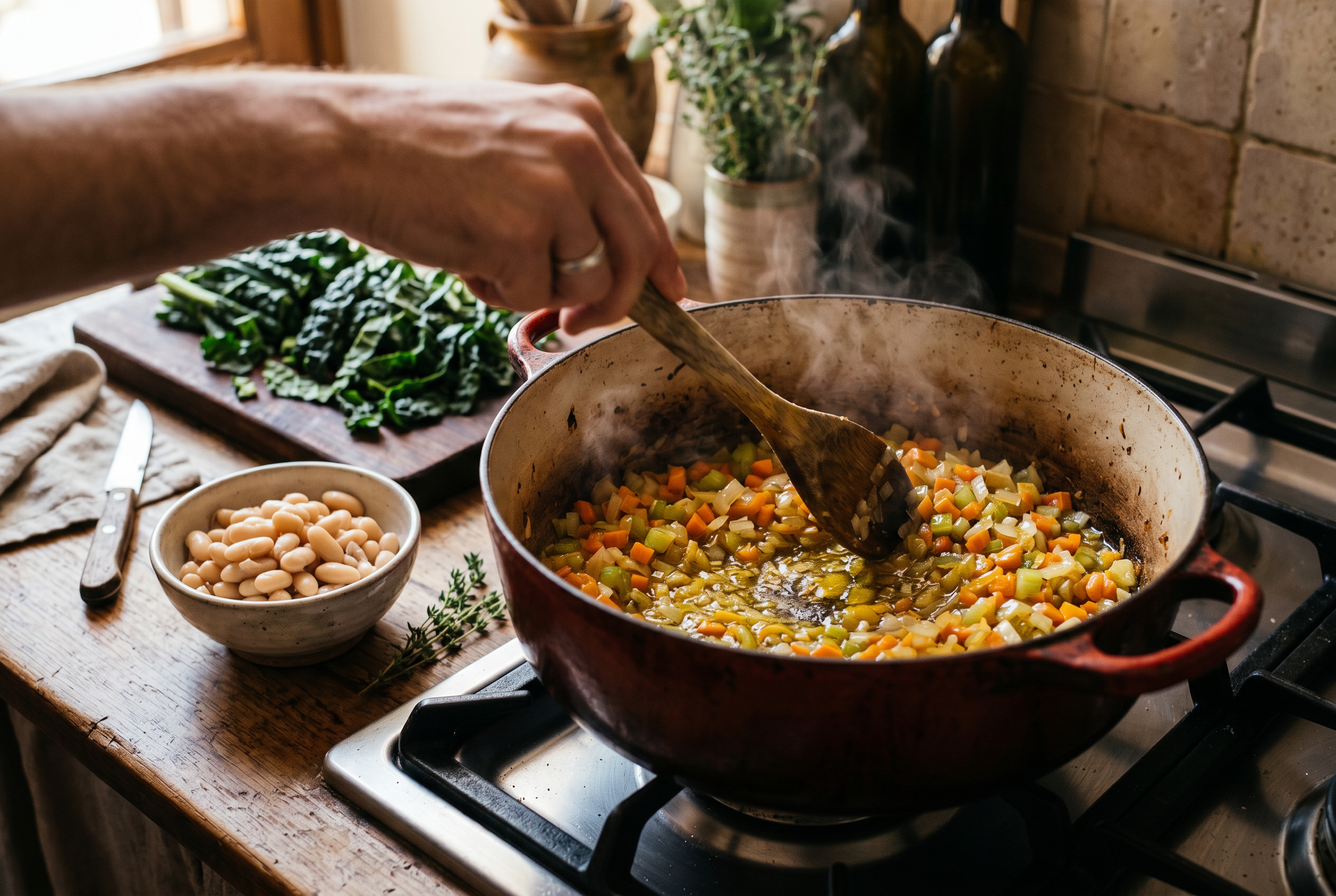
- Warm the olive oil in a large heavy pot or Dutch oven over medium heat for 30 to 45 seconds.
- Add the onion, carrot, and celery and cook for 7 to 8 minutes, stirring every 1 to 2 minutes, until softened and sweet but not browned.
- Stir in the grated garlic and cook for 30 seconds, until fragrant.
- Add the tomato paste and stir for 1 minute, until it darkens slightly and coats the vegetables - this builds depth of flavor.
- Pour in the crushed tomatoes and stir for 30 seconds.
- Add the vegetable broth, sea salt, black pepper, thyme, rosemary, and bay leaf, scraping the bottom of the pot so nothing sticks.
- Add the diced potato, bring to a gentle boil over medium-high heat, then reduce to low and simmer uncovered for 12 minutes, stirring every 4 minutes.
- Add the whole and mashed cannellini beans, the kale, cabbage, and zucchini, stirring until the greens wilt and submerge into the broth.
- Simmer uncovered for 18 to 20 minutes, stirring every 5 minutes, until the potato is tender and the broth looks slightly creamy.
- Stir in the bread cubes and simmer on low for 5 minutes, until the soup is thick and stew-like. Add water or broth 1/4 cup at a time if it becomes too thick.
- Turn off the heat, remove the bay leaf, and let the soup rest for 10 minutes so the bread softens fully and the flavors settle.
- Taste and adjust: add up to 1/8 teaspoon more sea salt if it tastes flat, a teaspoon of fresh lemon juice per bowl for brightness, or a pinch of red pepper flakes for mild heat.
- Ladle into shallow bowls, finish each with 1 teaspoon olive oil and a sprinkle of parsley, and serve hot.
Chef's Tips
- Make it gluten-free. Swap the rustic bread for a sturdy gluten-free loaf, or skip the bread entirely and stir in an extra 1/2 cup of mashed beans for body.
- Embrace the re-boil. Ribollita is named for being "re-boiled." Cool it completely, refrigerate overnight, and reheat the next day with 1/2 cup water or broth for the deepest, most authentic flavor.
- Store it well. Keep in an airtight container in the fridge for up to 4 days, and reheat gently over medium-low heat - avoid a hard boil so the bread does not stick to the pot.
- Freeze smart. Freeze the soup without the bread for the best texture, then add freshly toasted bread when you reheat.
- Swap the greens. No lacinato kale? Curly kale, savoy cabbage, or chard work well; tender spinach can be stirred in during the last few minutes.
Nutritional Information
Approximate per serving, based on 6 servings. Values are estimates and will vary with bread type, bean brand, broth sodium, and the amount of olive oil used.
Calories: about 355 kcal
Protein: about 13 g
Total Fat: about 13 g
Carbohydrates: about 50 g
Fiber: about 10 g
Sodium: about 640 mg
Key Nutrients Present: Protein, fiber, iron, folate, potassium, vitamin A, vitamin C, and vitamin K.
Key nutritional features: Cannellini beans contribute plant protein, fiber, iron, potassium, and folate; lacinato kale and cabbage add leafy-green nutrients and fiber; and extra-virgin olive oil brings unsaturated fats that anchor the Mediterranean character of the dish.
Nutrition values are approximate and may vary depending on ingredient brands, preparation method, and serving size.
Wellness Connection
Ribollita is a quiet lesson in how whole-food eating works as a system rather than a single fix. White beans bring plant protein and fiber, Tuscan kale and cabbage add leafy-green variety, and good olive oil ties it all together with Mediterranean-style fats. Eaten regularly, simple meals like this support the body as an interconnected whole - which is exactly how we think about nourishment at Hanuvier.
On busier days, a bowl like this pairs naturally with Hanuvier's Plant Protein & Collagen Booster, which combines plant protein with collagen-supporting nutrients in a single daily serving. Knowledge -> Mindset -> Wellness -> Beauty.
Frequently Asked Questions
Can I make ribollita gluten-free?
Yes. Use a sturdy gluten-free loaf in place of the rustic bread, or leave the bread out and stir in an extra 1/2 cup of mashed cannellini beans to keep the soup thick and hearty.
Can I use dried beans instead of canned?
Absolutely. Soak 1 1/4 cups dried cannellini beans overnight, drain and rinse, then simmer in fresh water until tender (usually 60 to 90 minutes). Use 3 cups of the cooked beans in the recipe.
How should I store and reheat it?
Keep it in an airtight container in the fridge for up to 4 days. Reheat gently over medium-low heat with 1/4 to 1/2 cup water or broth, and avoid an aggressive boil so the bread does not stick.
Can I freeze ribollita?
Yes. For the best texture, freeze the soup before adding the bread and stir in freshly toasted bread when you reheat. Leftovers that already contain bread will freeze fine but turn softer and thicker after thawing.
What can I use instead of lacinato kale?
Curly kale, savoy cabbage, or Swiss chard all work beautifully. Tender greens like spinach can be added in the last few minutes of simmering.
What is Hanuvier's systems-based approach to wellness and beauty?
The body functions as an interconnected system, with nutrients participating in multiple biological processes and often working alongside one another. Hanuvier uses this systems perspective to develop thoughtfully formulated products that support wellness, beauty, or both through a holistic approach rather than a single-ingredient focus.
Related Recipes & Articles
- Greek Fasolada - Traditional White Bean Soup - another rustic, plant-based white bean soup from our kitchen
- Moroccan Chickpea & Vegetable Tagine - a warmly spiced, one-pot plant-based meal
- Golden Turmeric Almond Milk - a soothing, anti-inflammatory drink to round out the meal
- Protein, Wellness, and Healthy Aging: The Science Behind Pea & Rice Protein - why plant protein matters beyond the gym
References & Editorial Notes
- UNESCO Intangible Cultural Heritage - Mediterranean diet: skills, knowledge, rituals, symbols, and traditions concerning food preparation, sharing, and community identity.
- UNESCO Mediterranean Diet Programme - on the Mediterranean diet and its recognition as intangible cultural heritage.
- La Cucina Italiana - Tuscan bean traditions and the role of cannellini beans in Tuscan cuisine.
- FoodData Central, U.S. Department of Agriculture - ingredient-level nutrition values for beans, vegetables, and olive oil.
- Editorial note: This recipe is intended for informational and educational purposes only. It is not medical advice and is not intended to diagnose, treat, cure, or prevent any disease.
Optional Note: Using Dried Beans
For a more traditional version, use 1 1/4 cups dried cannellini beans. Soak them overnight in water, then drain, rinse, and simmer in fresh water until tender - usually 60 to 90 minutes depending on the age and variety of the beans. Use 3 cups of the cooked beans in the recipe.
Make it a daily habit
Five collagen boosters and 20g of organic plant protein, every dose on the label.*
See what's inside HanuvierFree U.S. shipping · 60-day money-back guarantee · 10% off your first order
