
Vegan Japchae (Korean Glass Noodle Bowl)
Glossy Korean sweet potato glass noodles tossed with colorful sauteed vegetables, sesame oil, garlic, and a savory-sweet sauce - one of Korea's most beloved dishes, made fully plant-based
A systems based approach to wellness and beauty
Vegan recipe - 100% plant-based. No meat, poultry, fish or sea life, no eggs, and no dairy or honey.
Caution - Allergen & Dietary Alerts
Please read before making, especially if cooking for others.
- Soy (soy sauce / tamari): the sauce contains soy sauce or tamari. Why: soy is one of the most common food allergens. For a soy-free version, substitute coconut aminos - the flavor profile will be slightly sweeter but the dish will still work well.
- Sesame: this recipe uses toasted sesame oil throughout and sesame seeds as garnish. Why: sesame is a declared allergen in many countries. Omit both the sesame oil and sesame seed garnish for a sesame-free version, and use a neutral oil (avocado or sunflower) instead.
- Gluten (soy sauce): standard soy sauce contains wheat and is NOT gluten-free. Why: soy sauce is fermented with wheat. Use certified gluten-free tamari for a gluten-free version. The dangmyeon noodles themselves are made from sweet potato starch and are naturally gluten-free.
- Gluten (gochujang - optional): many gochujang brands contain wheat or rice flour. If using gochujang, check the label and use a certified gluten-free variety if needed. The recipe is written with gochujang as optional.
- Vegan as written - no meat, poultry, fish, shellfish, eggs, dairy, or honey. All ingredients are fully plant-based.
- Naturally egg-free, dairy-free, and meat-free.
- Gluten-free option: use certified gluten-free tamari in place of soy sauce and omit or substitute the gochujang. The dangmyeon noodles are naturally gluten-free. Always check individual product labels, as ingredients and "may contain" warnings vary by brand.
- Soy-free option: substitute coconut aminos for soy sauce or tamari. Reduce the maple syrup by half as coconut aminos are naturally sweeter.
Author, Editorial Note & Disclosure
The author brings over two decades of professional experience across biotechnology and pharmaceutical organizations, together with a long-standing passion for mindful nutrition, holistic wellness, and preventive health.
This recipe is intended for informational and educational purposes only. Nutritional estimates, where provided, are approximate and may vary based on specific ingredients, brands, and preparation methods used.
Jump To
About This Recipe
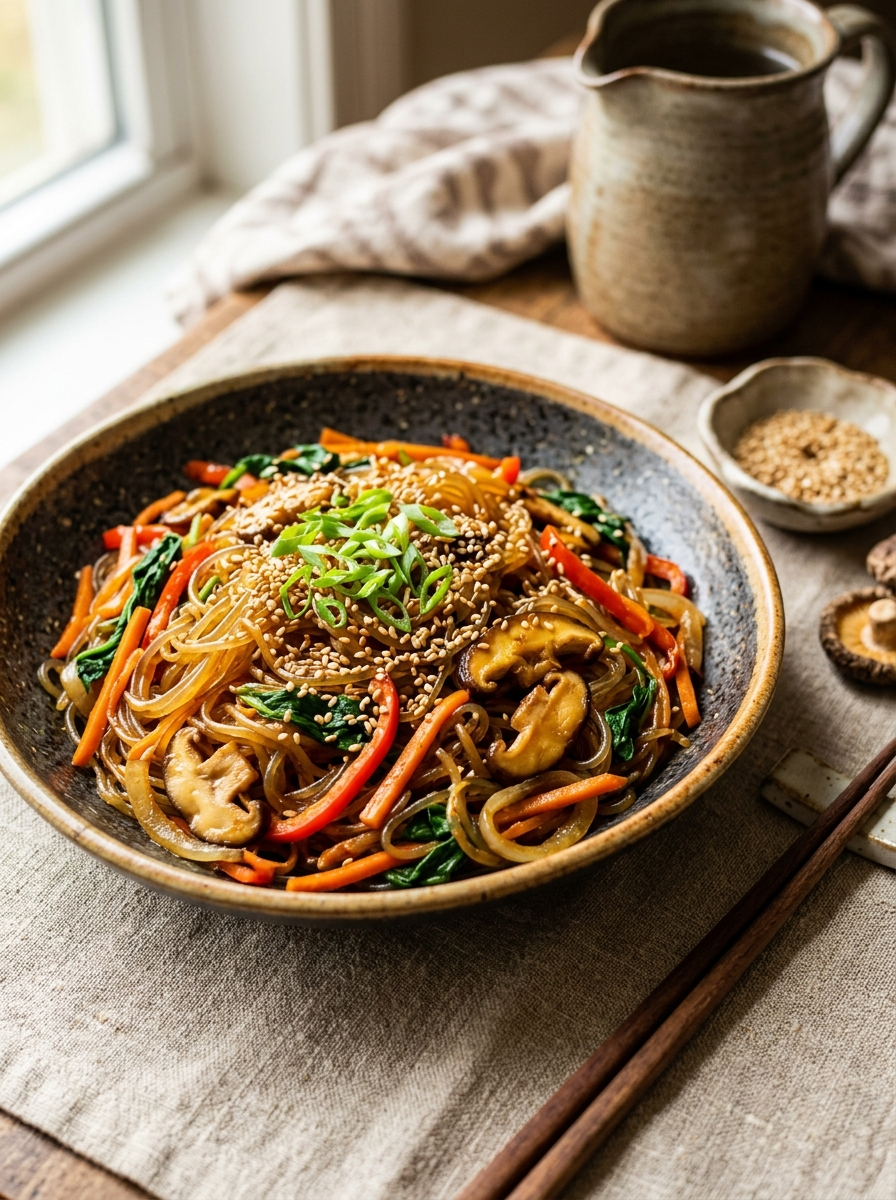
Japchae is one of Korea's most celebrated noodle dishes - the kind that appears at weddings, New Year tables, family celebrations, and holiday spreads. Its name is commonly understood as a mixed vegetable dish, and the cooking logic reflects that: it is less about any single ingredient and more about balance - the savory pull of soy sauce and garlic, the nutty warmth of toasted sesame oil, the gentle sweetness that rounds everything out, and the signature chew of Korean glass noodles made from sweet potato starch. When everything is properly tossed together, each glossy noodle carries a little of every flavor at once.
Those glass noodles - called dangmyeon - are what make japchae immediately recognizable. They are translucent, pleasantly chewy, and completely different in texture from wheat or rice noodles. Made entirely from sweet potato starch, they are naturally gluten-free and carry flavor exceptionally well. They also look beautiful: a finished japchae bowl is one of the most colorful dishes in Korean cooking, with orange carrots, red bell pepper, forest-green spinach, golden mushrooms, and cream-colored noodles all catching the light together.
This Hanuvier version keeps japchae fully plant-based - vegan from start to finish, without any compromises to the dish's flavor or character. If you follow a plant-based wellness routine, this bowl pairs beautifully with a smoothie from the Hanuvier Wellness Hub before or after your meal. The Matcha Sesame Smoothie echoes the sesame character of the noodles in a subtle and beautiful way, while the Berry Rose Smoothie offers a bright, floral contrast. Add Hanuvier's Plant Protein & Collagen Booster for a soft vanilla note and a systems-based formula - plant protein with a complete amino acid profile and 5 collagen-supporting nutrients, developed on the science of how wellness and beauty work together.
At a Glance
Prep Time: 30 minutes
Cook Time: 20 minutes
Total Time: 50 minutes
Servings: 4
Difficulty: Easy to Moderate
Dietary Tags: Vegan, Dairy-Free, Egg-Free. Naturally gluten-free when certified gluten-free tamari is used and gochujang is omitted or gluten-free. Contains soy and sesame - see Allergen Alerts above for soy-free and sesame-free options. Dangmyeon noodles are naturally gluten-free (sweet potato starch). Always check individual product labels.
Ingredients
For the Noodles
- 8 oz (225g) dangmyeon - Korean sweet potato starch glass noodles
- 8 cups water, for boiling
- 1 tsp toasted sesame oil, for tossing the cooked noodles
For the Vegetables
- 2 cups baby spinach, packed
- 1 tbsp neutral oil or avocado oil, divided
- 2 cups sliced mushrooms (shiitake, cremini, or oyster - or a combination)
- 1 medium carrot, cut into thin matchsticks (about 1 cup)
- 1 red bell pepper, cut into thin strips (about 1 cup)
- 1 small yellow onion, thinly sliced (about 1 cup)
- 3 scallions, thinly sliced - white and green parts separated
- 2 tsp fresh garlic, finely minced
For the Japchae Sauce
- 3 tbsp low-sodium soy sauce or tamari (use certified gluten-free tamari for a gluten-free version)
- 1 1/2 tbsp toasted sesame oil
- 1 tbsp rice vinegar
- 1 tbsp maple syrup or brown rice syrup
- 1 tsp fresh garlic, finely minced
- 1/4 tsp freshly ground black pepper
- 1 tsp gochujang - Korean fermented red chili paste (optional, for gentle heat)
For Garnish
- 1 tbsp toasted sesame seeds
- 1 tbsp thinly sliced scallion greens
- 1 tsp extra toasted sesame oil (optional, drizzled at serving)
Ingredient Notes
- Dangmyeon (Korean sweet potato starch noodles): also called Korean glass noodles. Translucent, chewy, and naturally gluten-free. Find them at Korean or Asian grocery stores, or online. Do not substitute with cellophane noodles made from mung bean starch - they behave differently when cooked.
- Tamari: a Japanese-style soy sauce that is typically lower in wheat content. For a fully gluten-free dish, use certified gluten-free tamari and check the label carefully.
- Gochujang: Korean fermented red chili paste. Mild heat level in this quantity. Omit entirely if you prefer no heat, or substitute 1/4 tsp Korean red pepper flakes (gochugaru).
- Toasted sesame oil: a strongly aromatic finishing oil. Use it carefully - the amount in this recipe is measured for balance. More is not better here.
Instructions
- Make the japchae sauce: in a small bowl, whisk together 3 tbsp soy sauce or tamari, 1 1/2 tbsp toasted sesame oil, 1 tbsp rice vinegar, 1 tbsp maple syrup, 1 tsp minced garlic, 1/4 tsp black pepper, and optional gochujang. Set the sauce aside.
- Blanch the spinach: bring a small pot of water to a boil. Add 2 cups packed baby spinach and cook for 20-30 seconds, just until wilted and bright green. Drain immediately and rinse under cold water. Squeeze gently to remove excess water, then roughly chop. Set aside in a large mixing bowl.
- Cook the glass noodles: bring 8 cups water to a boil in a large pot. Add 8 oz dangmyeon and cook according to package directions - typically 6-8 minutes - until the noodles are soft, chewy, and translucent throughout. Drain and rinse briefly with warm water. Use kitchen scissors to cut the noodles two or three times. Toss immediately with 1 tsp toasted sesame oil to prevent sticking. Set aside.
- Cook the mushrooms: heat 1 tsp neutral oil in a large skillet or wok over medium-high heat. Add 2 cups sliced mushrooms in a single layer and cook undisturbed for 2-3 minutes, then stir and cook for another 2-3 minutes until deeply browned and tender. Transfer to the large mixing bowl.
- Cook the remaining vegetables: add another 2 tsp neutral oil to the same skillet. Add the sliced onion and cook over medium heat for 3-4 minutes until softened. Add the julienned carrot and red bell pepper strips and cook for 3-4 minutes more until just crisp-tender. Add the scallion whites and 2 tsp minced garlic and cook for 30 seconds until fragrant. Transfer to the bowl.
- Combine and toss: add the cooked glass noodles and spinach to the large bowl. Pour the japchae sauce over the mixture. Toss vigorously for 1-2 minutes until the noodles are glossy and every strand is lightly coated with sauce.
- Taste and adjust: add 1 tsp soy sauce for more savory depth, 1 tsp rice vinegar for brightness, 1/2 tsp sesame oil for extra aroma, or 1 tsp maple syrup for a slightly sweeter profile. Adjust one element at a time.
- Serve: divide the japchae among 4 shallow bowls. Garnish with toasted sesame seeds, thinly sliced scallion greens, and an optional drizzle of sesame oil. Serve warm or at room temperature.
Chef's Tips
- Cook each vegetable separately. The single most important technique in a good japchae is cooking each component individually - mushrooms in one batch, carrots and peppers in another, spinach blanched separately. A crowded pan produces pale, watery vegetables.
- Cut the noodles after cooking. Dangmyeon noodles become very long once cooked. Use kitchen scissors to cut them 2-3 times directly in the strainer or bowl. This makes the japchae far easier to toss, serve, and eat.
- Make the sauce before you start cooking. The final toss comes together very quickly once all the vegetables and noodles are ready. Having the sauce already mixed means you can move fast at the end.
- Japchae is excellent at room temperature. Store leftovers in an airtight container for up to 3 days. Reheat gently in a skillet with 1-2 tbsp water, or enjoy at room temperature straight from the refrigerator.
- Add tofu or edamame for more protein. Pan-fry cubed firm tofu separately until golden, then toss in with the vegetables. Or stir in 1/2 cup shelled edamame at the end.
Nutritional Information
Approximate values per serving, based on 4 servings. Values will vary depending on noodle brand, oil measurement, sauce amount, and vegetable size.
- Calories: approximately 360-460 kcal
- Protein: approximately 7-10 g
- Carbohydrates: approximately 58-72 g
- Fat: approximately 10-14 g
- Fiber: approximately 5-8 g
- Key Nutrients Present: fiber, vitamin C (from bell pepper), vitamin A, vitamin K (from spinach), iron, potassium, magnesium, healthy fats (from sesame oil and seeds).
Nutrition values are approximate and may vary depending on ingredient brands, preparation method, and serving size.
Wellness Connection
Japchae is a good example of what plant-based cooking can look like when it is built for flavor first and nutrition follows naturally. Dangmyeon glass noodles provide satisfying carbohydrate energy without gluten. Shiitake mushrooms contribute savory depth and plant-based iron. Spinach adds vitamin K, vitamin A, and folate. Carrots and red bell pepper bring vitamin C. Sesame oil and sesame seeds supply healthy fats, magnesium, and calcium. Nothing in this bowl is incidental - every element is doing something.
At Hanuvier, wellness and beauty are understood as outcomes of consistent daily choices rather than any one ingredient. A bowl like this - colorful, plant-diverse, satisfying, and genuinely beautiful to look at - is what that approach looks like at the dinner table. Round out your day with a smoothie from the Hanuvier Wellness Hub: the Matcha Sesame Smoothie bridges the sesame-forward profile of this bowl beautifully, while the Pistachio Cardamom Smoothie offers a creamy, aromatic contrast. Add Hanuvier's Plant Protein & Collagen Booster for a soft vanilla note and a systems-based formula - plant protein with a complete amino acid profile and 5 collagen-supporting nutrients, developed on the science of how wellness and beauty work together.
Frequently Asked Questions
What is japchae?
Japchae is a Korean noodle dish made with dangmyeon - sweet potato starch glass noodles - tossed with sauteed vegetables, sesame oil, garlic, and a savory-slightly-sweet soy-based sauce. It is one of Korea's most recognized and beloved dishes, traditionally served at celebrations, holidays, and family gatherings. This Hanuvier version is fully vegan.
What are glass noodles made of?
Glass noodles can be made from several different starches depending on their origin. Korean glass noodles (dangmyeon) are made from sweet potato starch. Chinese glass noodles are often made from mung bean starch. All are naturally gluten-free and turn translucent once cooked. Sweet potato starch glass noodles have a chewier, more elastic texture and hold up better in sauced dishes like japchae.
Are glass noodles gluten-free?
Dangmyeon - Korean sweet potato starch glass noodles - are naturally gluten-free. However, japchae as a dish is not automatically gluten-free, because the sauce is made with soy sauce, which typically contains wheat. To make this recipe gluten-free, use certified gluten-free tamari in place of soy sauce, and either omit the gochujang or use a certified gluten-free brand. Always check individual product labels.
Are glass noodles healthy?
Dangmyeon glass noodles are primarily a carbohydrate source - naturally gluten-free, lower in calories than many pasta varieties, and easy to digest. What makes japchae a nutritionally rounded dish is everything that surrounds the noodles - mushrooms, spinach, carrots, bell pepper, garlic, and sesame all contribute fiber, vitamins, minerals, and healthy fats.
Can I make japchae ahead of time?
Yes - japchae is an excellent make-ahead dish. Prepare the full recipe, cool completely, and store in an airtight container in the refrigerator for up to 3 days. Reheat gently in a skillet with 1-2 tbsp water, or serve at room temperature directly from the refrigerator.
What is Hanuvier's systems-based approach to wellness and beauty?
The body functions as an interconnected system, with nutrients participating in multiple biological processes and often working alongside one another. Hanuvier uses this systems perspective to develop thoughtfully formulated products that support wellness, beauty, or both through a holistic approach rather than a single-ingredient focus.
Related Recipes & Articles
More Korean-inspired and Asian noodle recipes from the Hanuvier Wellness Hub
- Vegan Bibimbap - another Korean-inspired grain bowl with bold flavors and colorful vegetables
- Vietnamese Summer Rolls - fresh, light, and beautifully colorful plant-based rolls
- Japanese Miso Vegetable Soup - a deeply warming Asian-inspired plant-based bowl
Pair this bowl with a smoothie from the Hanuvier Wellness Hub
- Matcha Sesame Smoothie - earthy and sesame-forward, a natural complement to the japchae's flavor profile
- Pistachio Cardamom Smoothie - creamy and aromatic, a beautiful contrast to the savory noodles
- Berry Rose Smoothie - bright and floral, a refreshing follow-up to a savory bowl
From the Hanuvier Wellness Hub
Make it a daily habit
Five collagen boosters and 20g of organic plant protein, every dose on the label.*
See what's inside HanuvierFree U.S. shipping · 60-day money-back guarantee · 10% off your first order
