
Growth Mindset vs Fixed Mindset: The Beginning of Every Transformation
Before the first meal, the first workout, or the first new habit - there is a belief. And that belief determines everything that follows.
A systems based approach to wellness and beauty
By Vikas Tiwari, Founder, Hanuvier
About the author. Vikas Tiwari is the founder of Hanuvier and the author behind the Hanuvier Wellness Hub. His education spans science, law, and business: Chemistry, Physics, and Math as an undergraduate, followed by a degree in Law, a master's in Industrial Relations, and an MBA from the University of Maryland at College Park. He spent nearly two decades in executive roles across leading biotech organizations and global institutions, including The World Bank, Amgen, Myovant Sciences, and Sage Therapeutics, and advised major pharma companies such as Novartis, Novo Nordisk, and Boehringer Ingelheim through consulting engagements with Cognizant.
His philosophy. Nothing in the body works alone. The body is a coming together of many systems working in harmony - and wellness itself works the same way. Physical, emotional, and spiritual wellbeing are each systems in their own right, deeply interconnected and feeding off one another. That understanding is at the heart of Hanuvier: A Systems Based Approach to Wellness and Beauty, caring for the whole person, because no dimension of wellness stands alone.
Beyond his work. A vegetarian and vegan for 45 years, Vikas brings a lifelong passion for nutrition science, mindful living, and meditation. He believes knowledge is the first step on every wellness journey.
Editorial note & disclosure. This article is based on an objective review of publicly available scientific literature and educational resources referenced throughout. It is intended for informational and educational purposes only and should not be construed as medical advice.
Jump To:
- Why Some People Change and Others Never Begin
- Your Oldest Beliefs Are Running Your Newest Goals
- Mindset vs. Motivation - Know the Difference
- A Universal Law: Actions Bear Fruit
- Three Tools to Build Your Mindset
- Small Actions Compound: The Seedling Principle
- Mindset and the Body: A Two-Way Connection
- Why Mindset Comes First in the Hanuvier Framework
- Bringing It All Together
- Frequently Asked Questions
- Related Articles
- References
Why Some People Change and Others Never Begin
You have started before. Maybe many times.
The intention was real. The energy was genuine. And somewhere between the first step and the result - you stopped. Not because you are weak. Not because you do not care. Because something was missing underneath the effort.
That something is mindset.
Not motivation. Not willpower. Not the belief that it will be easy. Mindset is the deep conviction - tested against setbacks, against doubt, against the long stretches where nothing yet looks different - that your effort is building something real, even when you cannot see it. It is the foundation beneath every other step. Without it, nothing sticks. With it, everything becomes sustainable. This is what separates a genuine mindset transformation from another attempt that fades after three weeks.

Your Oldest Beliefs Are Running Your Newest Goals
The beliefs you carry about your own capability did not form this year. They formed through years of attempts, setbacks, and conclusions drawn in moments of failure. By the time you decide to change, those patterns are already in place - running quietly beneath every new effort.
This is how belief works. The mind repeats what it knows. The thought "I try and then I stop" - reinforced enough times - becomes the expected outcome before the next attempt even begins. Not consciously. Automatically.
That is where the question comes from:
"What if this doesn't work for me?"
That is not a rational conclusion. It is an old pattern surfacing. And patterns, unlike information, do not change just because you decide to act differently. They change through deliberate, repeated practice - which is exactly what building mindset means. Growth mindset science confirms this: the brain is not fixed. It responds to how you train it.
Most people reach for motivation when that pattern appears. What they actually need is something that does not depend on how they feel.
Mindset vs. Motivation - Know the Difference
Motivation is a feeling. Mindset is a conviction. They are not the same - and confusing them is why most good intentions eventually fail. Understanding motivation vs discipline is one of the most useful reframes in personal development.
Motivation rises when conditions are good. It disappears when they are not. Every person who has started a new routine and abandoned it three weeks later knows exactly how this works: the initial energy runs out, and with it, the action. This is not a character flaw. It is simply the nature of emotion - unreliable by design.
Mindset does not run out. It is not contingent on how you feel today.
Motivation says: "I feel ready."
Mindset says: "I will go, ready or not."
Motivation starts journeys. Mindset is what carries them through the weeks when nothing is going right, progress is invisible, and every reason to quit feels entirely reasonable. This is the real meaning of motivation vs discipline - discipline is not about forcing yourself, it is about having built a conviction strong enough to not require a feeling.
If motivation is your primary fuel, you will run dry. So what do you build instead? The answer has been sitting in plain sight for centuries - across cultures, disciplines, and traditions that never spoke to each other.
A Universal Law: Actions Bear Fruit
Across centuries and cultures, independent traditions arrived at the same conclusion. Hindu philosophy's concept of Karma holds that intentional actions carry consequences that unfold over time - the seed and the fruit are always connected, even when they do not appear together. The Bhagavad Gita taught full effort with patience for outcomes. Buddhist teachings trace deliberate action to future experience through accumulated causes and conditions. Stoic philosophy - from Marcus Aurelius to Seneca - taught the same discipline: control your actions, trust that results follow effort over time. Viktor Frankl, writing from history's darkest setting, observed that even when almost everything had been taken from a person, one freedom remained: the freedom to choose one's response - and thereby shape one's own future.13
Modern science arrived at the same conclusion through an entirely different path. Dweck's growth mindset vs fixed mindset research found that believing abilities can grow through effort leads to more persistence and better outcomes.1,2 Duckworth found that grit and perseverance - not talent - predict long-term success.3,4 Seligman found that viewing setbacks as temporary leads to greater resilience and recovery.7,8 Bandura's work on self-efficacy and health found that belief in one's own capacity to act changes how effectively one acts.9 Neuroplasticity brain change research found that the brain physically rewires itself through repeated thought and practice - the habits of mind you practice most are, quite literally, being strengthened.14
Different languages. Different centuries. Different methodologies. One conclusion: actions bear fruit.
This is not a motivational phrase. It is a universal law - attested by ancient philosophy and confirmed by modern science from multiple independent angles. Effort compounds. Practice reshapes the brain. Belief shapes behavior. Consistent action produces outcomes. The fruit always comes - but on its own timeline, not yours.
Knowing this - really knowing it - is itself a powerful tool for building mindset. Because the question is no longer whether effort works. It does. The question is how to keep taking action when the fruit is not yet visible. Carry this law with you into everything that follows.
Three Tools to Build Your Mindset
Now that you know the law - that actions bear fruit, that sincere effort compounding over time always produces change - carry it with you into each of these tools. They are not motivational tricks. They are practical methods for staying anchored to that law on the days when the fruit is not yet visible. The law is the base. These tools are how you build on it.
1. Add the Word "Yet"
When you notice a thought that closes a door - "I can't do this," "This doesn't work for me," "I'm not the kind of person who succeeds at this" - add a single word: yet. "I haven't figured this out yet." "I haven't reached my goal yet." That word transforms a closed door into an open one. It is the most accessible entry point into growth mindset vs fixed mindset thinking - and it is the linguistic expression of the universal law itself. Your actions are bearing fruit. You simply have not reached the harvest yet.
2. Build the System, Not the Motivation
Stop waiting to feel inspired before taking action. Instead, build the conditions that make the action easier to do than to skip - a consistent time, a prepared environment, a small and specific commitment. Habit formation science shows that small actions performed consistently tend to become automatic over time.5,6 Once an action is a habit, it no longer requires motivation to initiate. This is the practical answer to motivation vs discipline - a system removes the daily negotiation entirely. You are keeping the compounding alive without requiring willpower each time.
3. Change What You Say to Yourself
The most consequential conversation in your journey is the one you have with yourself. Most people carry a background voice that quietly undermines progress: "What if this doesn't work for me?" Recognize that voice as a habit of interpretation - not a statement of fact. Replace it, deliberately and repeatedly, with the one thing you now know to be true: actions bear fruit. Say it as fact, because it is - confirmed by ancient philosophy and modern science alike. Not a feeling. Not a hope. A law. And when you miss a day or make a mistake, self-compassion and motivation research suggests that extending yourself patience after setbacks sustains progress better than self-criticism does.15 This is mindset and behavior change in its most practical form.
These three tools share one demand: patience. And patience requires understanding something fundamental about how change actually moves through time.

Small Actions Compound: The Seedling Principle
Here is the trap most people fall into: they expect to feel the results before the results are ready. When early effort produces no visible change, doubt enters. And doubt is where momentum goes to die - not because the law failed, but because the measurement came too soon.
Mindset transformation is not built on dramatic turning points. It is built on hundreds of small decisions, repeated over time, each one feeling unremarkable on the day it is made. One walk. One nutritious meal. One commitment kept when skipping would have been easier. Whether you are pursuing mindset for weight loss, mindset and wellness, or any other personal goal - these small acts do not feel like progress. They are progress - invisible, compounding, and real.
A seedling does not look different from one day to the next. Tended consistently, it becomes something that could not have existed otherwise. The law is working. The fruit is coming. Mindset is what keeps you tending it when you cannot yet see the growth. And nowhere is this patience more powerfully tested - or more richly rewarded - than in the relationship between mind and body.
Mindset and the Body: A Two-Way Connection
Mindset is not only a psychological concept. Research suggests the relationship between mental state and physical wellbeing runs in both directions.11,12 Self-efficacy and health research is clear: a constructive mindset supports the behaviors - consistent movement, deliberate nutrition, quality sleep - that are themselves associated with physical wellbeing. And those physical improvements, in turn, may strengthen mental clarity, energy, and the capacity for further effort.
Someone who approaches their health with a growth mindset in adults - whether they are 30 or 60 - is more likely to return after a missed workout, to view a difficult week as a temporary deviation rather than a permanent failure, and to maintain the long-term consistency that underlies most meaningful health outcomes. Mindset and wellness are not separate topics. They are deeply woven together. Which is precisely why, in the Hanuvier framework, mindset is not an afterthought. It is the foundation.
Why Mindset Comes First in the Hanuvier Framework
Within the Hanuvier philosophy, both core frameworks begin with a single step: Mindset. The ordering is intentional.
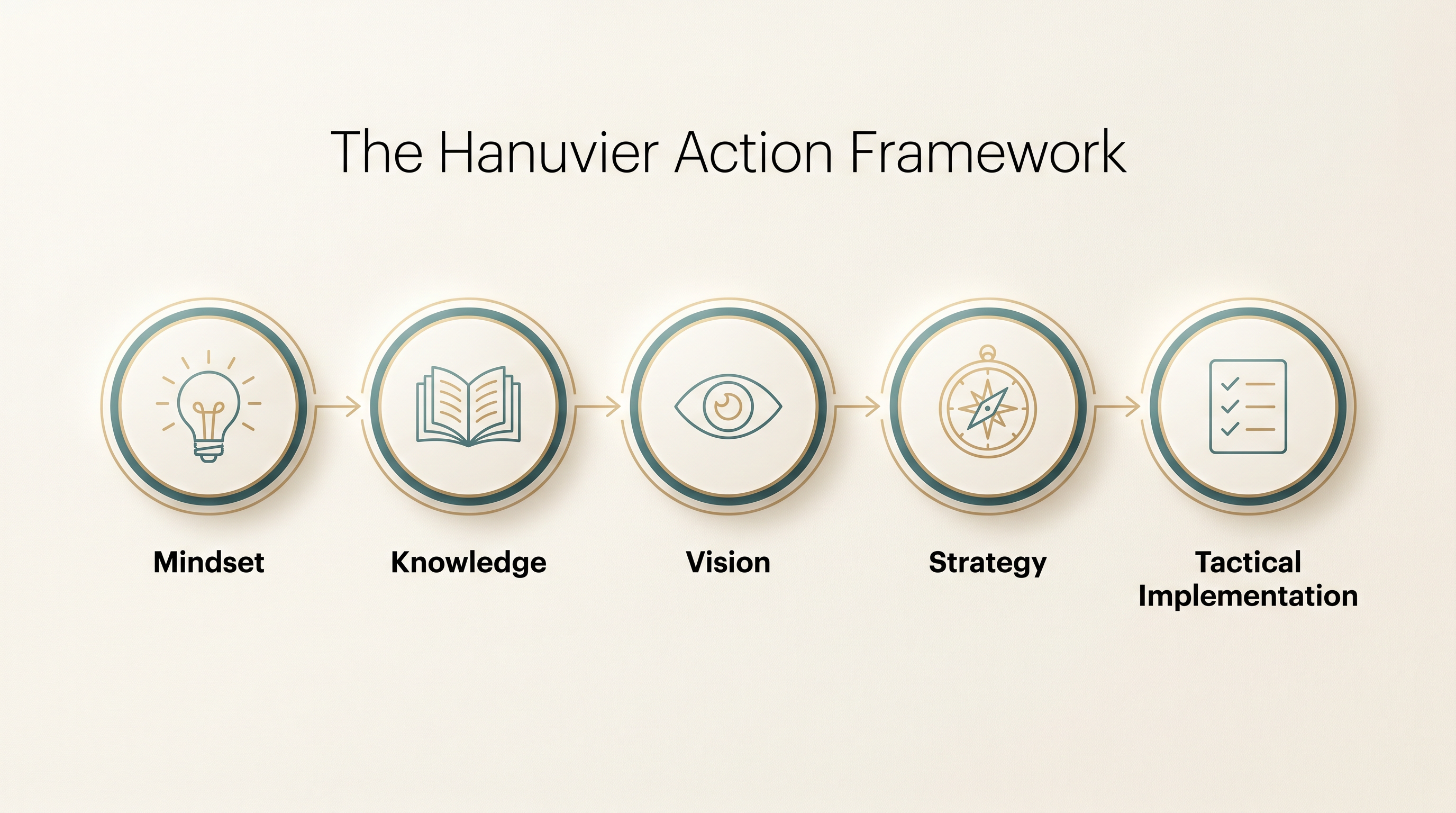
Without mindset, people rarely pursue knowledge consistently. Without knowledge, vision remains unclear. Without clear vision, strategy is weak. Without strategy, action becomes inconsistent. Without consistent action, outcomes do not materialize. Remove mindset from the beginning of that chain and every step that follows becomes fragile. This is why growth mindset in adults is not a soft concept - it is the structural foundation of any self-improvement mindset that actually produces lasting change.
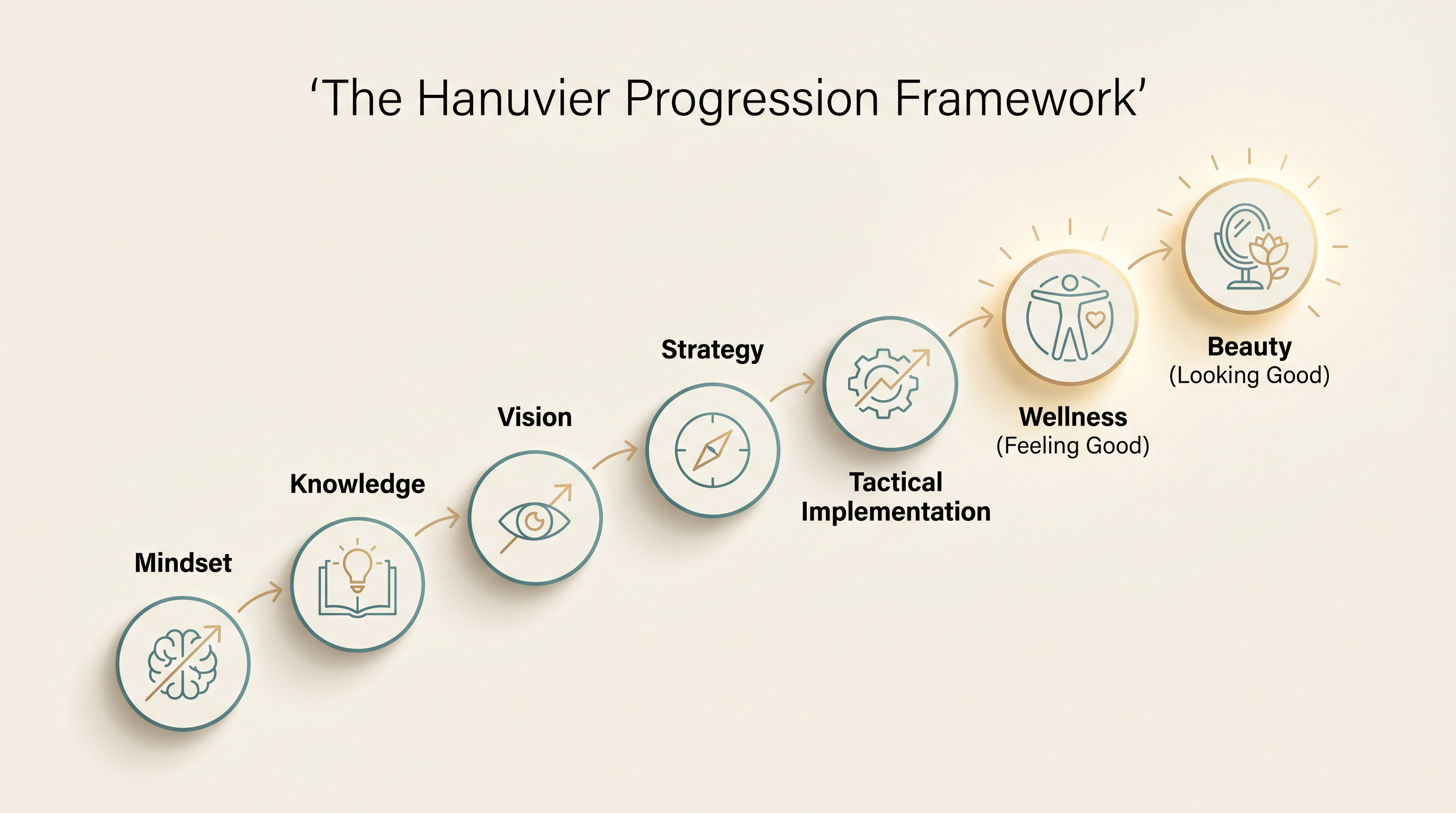
The frameworks are not purely linear - each step reinforces the others. Better physical wellbeing may strengthen mindset. Stronger mindset may deepen commitment to learning. Deeper knowledge sharpens vision and refines strategy. Better strategy produces more consistent outcomes, which further reinforce belief. The cycle builds on itself - but only if mindset is at the foundation, present and active at every iteration.
Your Roadmap
The Mindset Journey
The Obstacle
Old belief patterns run automatically beneath every new effort
"What if this doesn't work for me?"
The Distinction
MOTIVATION
A feeling
Rises and falls
Starts journeys
MINDSET
A conviction
Does not run out
Sustains journeys
The Foundation
A Universal Law: Actions Bear Fruit
Ancient philosophy and modern science - independent paths, one conclusion. Effort compounds. The fruit always comes - on its own timeline, not yours.
The Practice - Three Tools
Add "Yet"
Your actions are bearing fruit. You have not reached the harvest yet.
Build the System
Honor the law even when you cannot feel it working.
Change the Voice
Replace the old pattern with the one truth everything confirms.
The Timeline
Small Actions Compound
Invisible progress becomes visible outcomes. The law is working. The fruit is coming. Trust the timeline.
The Outcome

Bringing It All Together
Here is what this article has been building toward.
The reason you have stopped before is not discipline. It is not effort. It is that old belief patterns - formed through years of repeated experience - were running quietly in the background, turning slow results into evidence that change was not possible for you. That pattern is not a verdict. It is a habit. And habits change through deliberate, repeated practice.
Mindset is that practice. Not motivation - motivation runs dry. A conviction, built deliberately and maintained through difficulty, that your effort is compounding into something real even when you cannot yet see it. Whether you are pursuing mindset transformation for wellness, for fitness, for weight loss, or for any aspect of your life - this conviction is what makes the difference.
That conviction rests on a foundation that ancient philosophy and modern science confirm: actions bear fruit. The fruit always comes. On its own timeline, not yours.
Three tools keep you anchored to that truth when the timeline feels long. Add "yet" - your actions are still bearing fruit. Build the system - honor the law even when you cannot feel it working. Replace the old voice - with the one fact that everything confirms. Do these things, repeatedly and imperfectly, and you are not just working toward change. You are already in it.
Mindset is not the most visible step in the journey. It is the first. Without it, no other step holds long enough to produce what you are actually capable of.
Begin here. Everything else follows.
Frequently Asked Questions
What is the difference between growth mindset vs fixed mindset?
A growth mindset - as defined by Dweck's research - is the belief that abilities and intelligence can be developed through effort, learning, and persistence.1 A fixed mindset is the belief that abilities are static and cannot meaningfully change. The growth mindset vs fixed mindset distinction matters enormously in practice: people with a growth mindset are more likely to persist through setbacks, view challenges as learning opportunities, and achieve better long-term outcomes across health, education, and personal development.
Why do I keep stopping, even when I genuinely want to change?
Because wanting is not the same as being equipped. Belief patterns formed over years run automatically - long before conscious intention kicks in. When early results do not appear on the timeline you expected, an old pattern surfaces: "This won't work for me." That is not a rational conclusion. It is a groove the mind has worn through repetition. You are not weak. You are running on outdated programming. Mindset and behavior change is how you rewrite it - deliberately, repeatedly, over time.
What is the real difference between motivation vs discipline?
Motivation is a feeling - it rises when conditions are good and disappears when they are not. Discipline - or more accurately, mindset - is a conviction that does not depend on how you feel today. The motivation vs discipline question misses a deeper point: both motivation and willpower are unreliable over time. What you actually want to build is a conviction grounded in knowing that effort produces change. That conviction, supported by habit formation science, makes the daily decision to act almost automatic.
Can belief patterns actually change through neuroplasticity?
Yes - and neuroplasticity brain change research is unambiguous on this. The brain physically reshapes itself through repeated thought and practice.14 The patterns you practice most are the ones that become automatic. The belief "I try and stop" became a pattern through repetition. A new belief - "effort produces change over time" - becomes a pattern the same way. This is not motivational language. It is how the brain actually works.
How does habit formation science support mindset building?
Habit formation science shows that small actions performed consistently tend to become automatic over time - removing the need for motivation or willpower to initiate them.5,6 This is why building a system matters more than seeking inspiration. Once the action is habitual, self-improvement mindset becomes self-reinforcing - the results of consistent action strengthen the belief that drove the action in the first place.
Does mindset affect physical wellness as well as mental wellness?
Research suggests the connection runs in both directions.11,12 Self-efficacy and health studies show that a constructive mindset supports the behaviors - consistent movement, deliberate nutrition, quality sleep - associated with long-term physical wellbeing. And those physical improvements, in turn, strengthen mental clarity and the capacity for further effort. Mindset and wellness are not separate conversations. They are the same conversation.
Why does mindset come first in the Hanuvier framework?
Because without it, nothing else holds. Knowledge without mindset stays information. Strategy without mindset stays a plan. Effort without mindset stops before it compounds. Every step in the Hanuvier framework - from knowledge to vision to strategy to action - depends on a foundation that keeps the chain functioning through difficulty, doubt, and slow progress. That foundation is mindset. Build it first, and everything else becomes possible.
What is Hanuvier's systems-based approach to wellness and beauty?
The body functions as an interconnected system, with nutrients participating in multiple biological processes and often working alongside one another. Hanuvier uses this systems perspective to develop thoughtfully formulated products that support wellness, beauty, or both through a holistic approach rather than a single-ingredient focus.
Related Articles
- Wellness and Beauty: Can One Truly Exist Without the Other?
- Looking Your Best Is a Strategy, Not an Accident
- Is Protein Alone Enough? The Case for a Systems-Based Approach to Wellness
- Collagen vs. Collagen Boosters: A Smarter Approach to Supporting Natural Beauty
- Hyaluronic Acid, Biotin, Zinc, L-Lysine & Hydroxyproline: The Science Behind Five Key Nutrients
References
1. Dweck CS. Mindset: The New Psychology of Success. Random House; 2006.
2. Dweck CS. Mindsets and Human Nature. American Psychologist. 2012;67(8):614-622.
4. Duckworth A. Grit: The Power of Passion and Perseverance. Scribner; 2016.
5. Lally P, et al. How Are Habits Formed? European Journal of Social Psychology. 2010;40(6):998-1009.
7. Seligman MEP. Learned Optimism. Vintage Books; 2006.
8. Seligman MEP. Flourish. Free Press; 2011.
10. American Psychological Association. Building Your Resilience.
11. National Institutes of Health. Emotional Wellness Toolkit.
12. World Health Organization. Mental Health: Strengthening Our Response.
13. Frankl VE. Man's Search for Meaning. Beacon Press; 1959.
14. Doidge N. The Brain That Changes Itself. Penguin Books; 2007.
Built on the nutrients in this article
Five collagen boosters and 20g of organic plant protein, every dose on the label.*
See what's inside HanuvierFree U.S. shipping · 60-day money-back guarantee · 10% off your first order
