
Science & Wellness
Hyaluronic Acid Explained: What It Is, What It Does in the Body, and How to Support It
The water-holding molecule behind hydrated skin, cushioned joints, and healthy aging
A systems based approach to wellness and beauty
By Vikas Tiwari, Founder, Hanuvier
About the author. Vikas Tiwari is the founder of Hanuvier and the author behind the Hanuvier Wellness Hub. His education spans science, law, and business: Chemistry, Physics, and Math as an undergraduate, followed by a degree in Law, a master's in Industrial Relations, and an MBA from the University of Maryland at College Park. He spent nearly two decades in executive roles across leading biotech organizations and global institutions, including The World Bank, Amgen, Myovant Sciences, and Sage Therapeutics, and advised major pharma companies such as Novartis, Novo Nordisk, and Boehringer Ingelheim through consulting engagements with Cognizant.
His philosophy. Nothing in the body works alone. The body is a coming together of many systems working in harmony - and wellness itself works the same way. Physical, emotional, and spiritual wellbeing are each systems in their own right, deeply interconnected and feeding off one another. That understanding is at the heart of Hanuvier: A Systems Based Approach to Wellness and Beauty, caring for the whole person, because no dimension of wellness stands alone.
Beyond his work. A vegetarian and vegan for 45 years, Vikas brings a lifelong passion for nutrition science, mindful living, and meditation. He believes knowledge is the first step on every wellness journey.
Editorial note & disclosure. This article is based on an objective review of publicly available scientific literature and educational resources referenced throughout. It is intended for informational and educational purposes only and should not be construed as medical advice.
- Introduction
- What is hyaluronic acid?
- What is it made of?
- Will it elevate my sugar levels?
- What does it do in the body?
- Does the body make it, and how much?
- How does it change as we age?
- What happens when levels run low?
- Natural ways to support it
- Lifestyle habits that protect it
- How people supplement it
- What to pair it with
- The Hanuvier framework
- Bringing it all together
- Frequently asked questions
- Related articles
- References
Introduction
Hyaluronic acid has become one of the most talked-about molecules in skincare and wellness, yet most of the conversation stops at the surface of the skin. Its story actually begins much deeper, inside almost every tissue you have. Here is what the science says about what it is, what it is made of, the roles it plays, what happens as its levels change, and the everyday, natural ways people choose to support it.
What is hyaluronic acid?
Hyaluronic acid, also called hyaluronan, is a soft, slippery, gel-like substance your body produces naturally.1 Think of it as the molecule that helps tissues stay cushioned, lubricated, and hydrated. Its defining trait is an extraordinary appetite for water: it can hold a remarkable amount of moisture relative to its own weight. To put that in perspective, the Cleveland Clinic notes that a quarter-teaspoon of hyaluronic acid can hold roughly one and a half gallons of water.1 That water-loving quality is the thread running through nearly everything it does.
What is it made of?
Here is the reassuring part: hyaluronic acid is not exotic chemistry. It is built from just four everyday atoms, the same basic building blocks found in the sugars and proteins in your food: carbon, hydrogen, oxygen, and nitrogen. These atoms come together to form two simple sugar-like units, and those two units link up and repeat, over and over, like beads threaded on a very long string.3
Two simple sugar units alternate and repeat thousands of times, forming one long chain. Scientists group molecules like this under the name glycosaminoglycans, but the everyday idea is simpler: a long, water-loving strand made of sugars.3
If it is made of sugar, will it elevate my sugar levels?
It is a fair question, and the answer is reassuring: no. Despite the name, hyaluronic acid does not behave like the sugar in your kitchen. Its "sugar units" are structural building blocks locked into one very long chain, not the loose, free sugar the body burns for quick fuel.3 It is not sweet, it is not counted as a dietary sugar, and it is not used by the body as a source of blood sugar the way sweetened foods and drinks are.
A helpful comparison: cotton and table sugar are both, technically, carbohydrates, yet nobody worries about cotton tasting sweet or affecting them like a dessert. The form the sugar is locked into completely changes how the body treats it. Hyaluronic acid is firmly in that structural camp, a building material rather than a fuel.
What does it do in the body?
Because hyaluronic acid draws in and holds water so effectively, it is involved in keeping tissues plump, resilient, and well-lubricated. Research and clinical references describe several roles:1

Skin: It contributes to the skin's moisture reserves and helps the skin stay supple and elastic.1
Joints: It is a major component of the fluid that cushions and lubricates the joints, helping surfaces glide smoothly.1
Eyes: It is naturally present in the gel-like interior of the eye, where it helps maintain structure and hydration.1
Tissue and structure: It is part of the extracellular matrix, the scaffolding that surrounds our cells, and plays a role in the body's natural tissue-repair processes.3
Does the body make it, and how much?
Yes. Hyaluronic acid is made by the body itself, by a group of enzymes (called hyaluronan synthases) that sit at the surface of our cells and assemble the chains directly.3 A commonly cited estimate is that an average adult carries roughly 15 grams of hyaluronic acid at any given time, and that about a third of it is broken down and rebuilt every single day.2
A quick note on that 15-gram figure: it is a rough average for a typical healthy adult of around 70 kg (about 154 lb), not a precise number for every person.2 It is not broken down by age or gender in the way a lab value would be, and the real amount naturally varies with body size and, importantly, with age. Treat it as a helpful ballpark, not a fixed target.
That daily turnover, constantly breaking down and remaking about a third of the supply, is a feature rather than a flaw. It lets the body refresh and remodel its tissues continuously. In a healthy, well-nourished young body, production and breakdown stay in comfortable balance.
How does it change as we age?
This is the question that matters most, and the honest answer is: both sides of the balance shift, and they shift in different ways.
Production slows down. The body's own output of hyaluronic acid is thought to begin easing from around the age of 25.4 The cells that make it (skin fibroblasts) become fewer and less active over time, and the enzymes that build the chains wind down.4 You can see the effect in tissue measurements: skin hyaluronic acid has been measured at roughly 0.3 mg per gram of tissue in adults aged 19 to 47, falling to around 0.07 mg per gram in those aged 75 and older.4
Breakdown speeds up, mostly from the outside. On top of slower production, everyday exposures accelerate how fast hyaluronic acid is broken apart. Sunlight (UV) is the biggest culprit here: it raises the activity of the enzymes that fragment hyaluronic acid and generates reactive molecules that chop the chains into smaller pieces.4 This is why sun-exposed skin tends to show the effects of aging sooner than protected skin.
So it is not one or the other. Internally, we simply make less as the years pass; externally, sun and oxidative stress take more. Understanding that split is useful, because while we cannot pause the clock on production, we have real influence over the breakdown side.
What happens when levels run low?
First, an important clarification: hyaluronic acid is not a vitamin, and there is no standard blood test or formal "deficiency" diagnosis for it the way there is for iron or vitamin D. The body makes its own, so this is about the balance gradually tipping toward less, not a nutrient running out.
When that balance tips, the signs are mostly things you can see and feel rather than something a lab flags. Because hyaluronic acid's whole job is holding water, lower levels are commonly associated with:4
Skin that feels drier and less bouncy, a loss of that plump, cushioned quality, and skin that takes a moment longer to "spring back."4
More noticeable fine lines and a loss of firmness, as the skin's water-holding scaffold thins.4
Joints that feel less cushioned or a little stiffer, since hyaluronic acid is part of the fluid that keeps them moving smoothly.1
Eyes and other tissues feeling drier in some people, reflecting the same loss of moisture-holding capacity.1
These signs are general and can have many other causes, so they are best read as gentle cues rather than a diagnosis. If any concern is persistent or troubling, a healthcare professional is the right person to see.
Natural ways to support it
You cannot eat hyaluronic acid directly into your skin, but a nourishing diet gives the body the raw materials and cofactors it uses to make and protect its own. The evidence here is still developing, so think of these as sensible, food-first habits that support the wider picture:
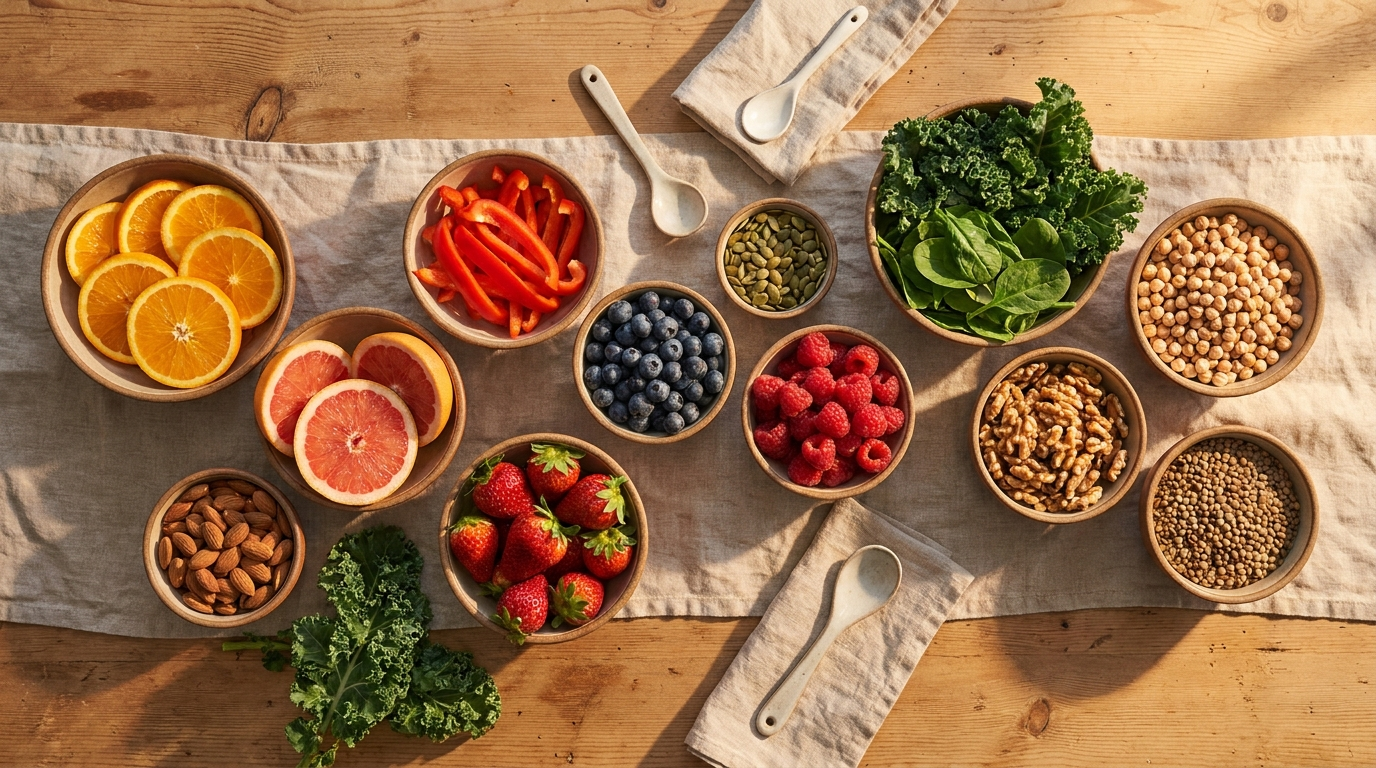
Vitamin C-rich foods (citrus, berries, peppers, leafy greens) support the body's natural collagen production, and collagen shares the skin's matrix with hyaluronic acid.6
Magnesium-rich foods (leafy greens, nuts, seeds, whole grains, legumes) provide a mineral involved in the body's production processes.
Zinc sources (pumpkin seeds, legumes, whole grains) supply a mineral that participates in skin maintenance and tissue processes.7
Colorful, antioxidant-rich produce helps the body counter the oxidative stress that speeds hyaluronic acid breakdown.4
Enough quality protein supplies the amino acid building blocks tissues draw on, and traditional foods such as bone broth and soy-based foods are often included in a hyaluronic-acid-friendly diet.
Lifestyle habits that protect it
Because so much hyaluronic acid loss comes from the breakdown side, the day-to-day choices that slow that breakdown are some of the most useful things you can do. The quiet bonus is that every one of these habits supports far more than hyaluronic acid alone.
Protect your skin from the sun. Daily sun protection is the single biggest lever, since UV is the main external degrader.4 The same habit also supports collagen and overall skin health.
Don't smoke, and limit excess sugar. Both add to the oxidative and glycation stress that ages skin. Cutting back supports circulation, collagen, and general wellbeing too.
Stay hydrated. Hyaluronic acid can only hold the water that is available to it, so consistent hydration supports its work and supports energy and overall function.
Eat the rainbow and prioritise sleep. Antioxidant-rich foods and good rest help the body manage the daily wear-and-tear that degrades tissues, with benefits that reach well beyond the skin.
Notice the pattern: sun care, not smoking, less sugar, more water, colorful food, and good sleep are the same foundations that support healthy aging across the board. Caring for your hyaluronic acid is really just caring for your whole system.
How people supplement it
There are two main routes, and they serve different purposes. Topical hyaluronic acid (serums and creams) works at the surface, helping the outer skin hold moisture. Oral hyaluronic acid takes a from-within approach; taken by mouth, larger molecules are broken down in the gut into smaller fragments that can be absorbed.5 The research here has grown notably stronger. In a 2025 randomized, double-blind, placebo-controlled trial in 150 healthy adults, participants taking oral sodium hyaluronate at 60 mg or 120 mg per day for 12 weeks showed measurable improvements in skin hydration (up to about 11.5 percent on the cheek) alongside reductions in the depth of fine lines, compared with placebo.5 Study doses commonly fall in the range of roughly 60 to 240 mg per day taken consistently over 8 to 12 weeks, which reflects how this molecule tends to work: gradually, as part of a routine.
What to pair it with
Hyaluronic acid rarely works in isolation in the body, which is exactly why a systems-based approach makes sense. Four simple companions do the most to support it:
Vitamin C: required for the body's natural collagen production, the structural partner that shares the skin's matrix with hyaluronic acid.6
Zinc: a mineral that participates in skin maintenance and the body's tissue-support processes.7
Protein: supplies the amino acid building blocks that tissues rely on to renew themselves.
Water: the simplest partner of all. Hyaluronic acid's entire role is holding water, so staying well hydrated gives it something to hold.
The theme is consistency and balance rather than any single hero ingredient. This is the thinking behind Hanuvier's plant protein and collagen-support formulation, which brings several of these nutritional elements together in one system rather than treating them as separate, single-ingredient fixes.
The Hanuvier framework
Understanding a molecule like hyaluronic acid is really the second step in a larger journey. At Hanuvier, we see wellness as a progression that starts with mindset and knowledge, turns into a clear vision and strategy, and finally becomes the small daily actions that add up over time.

Wellness comes first, and beauty follows as its visible expression. Looking good is an outcome of feeling good, not the starting point. These small daily actions, repeated with intention, are what turn knowledge into visible results over time.
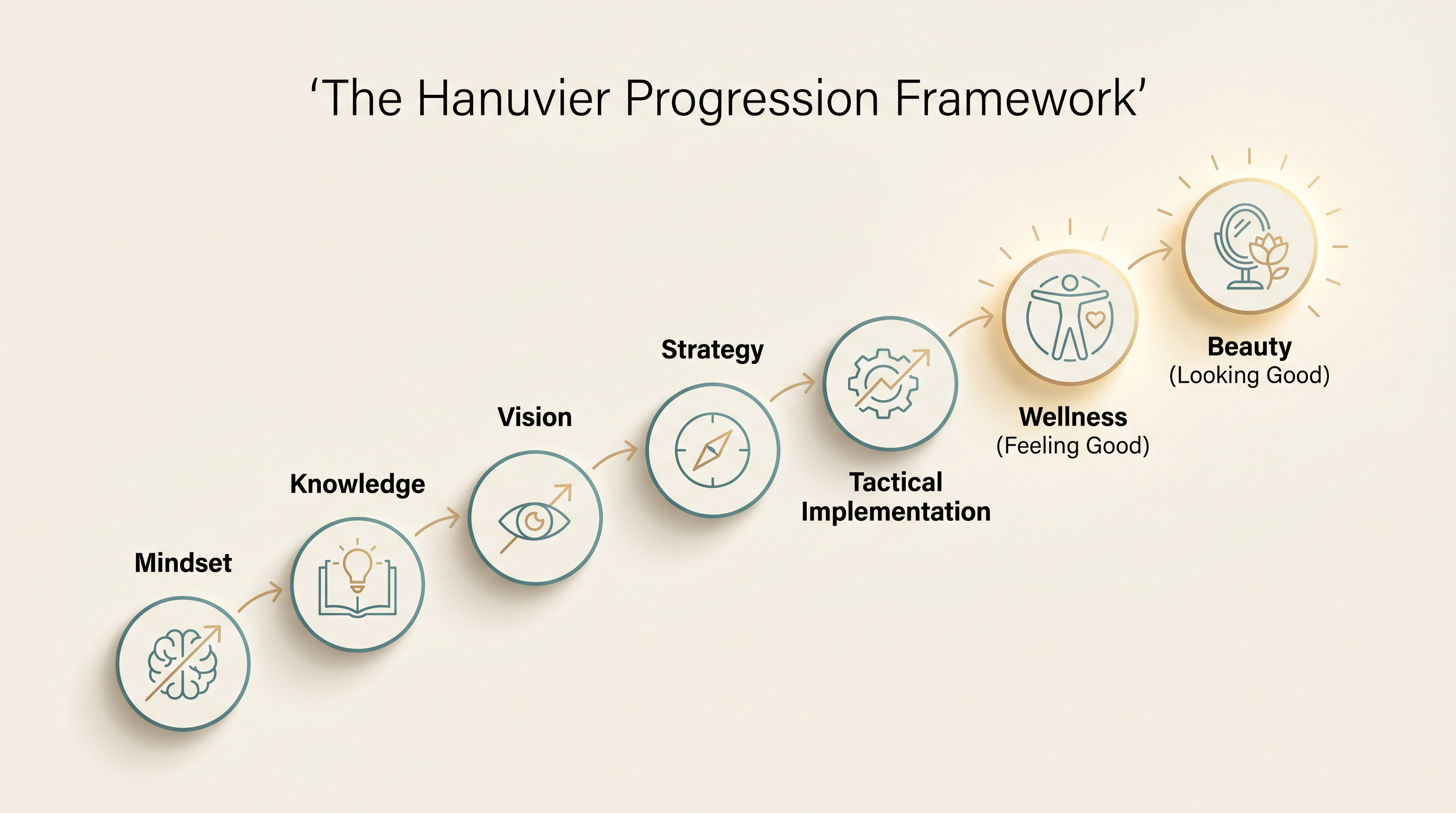
Seen this way, a single molecule like hyaluronic acid is never the whole answer. It is one thread in a much larger, interconnected system, and supporting the system is what supports the molecule.
Bringing it all together
Hyaluronic acid is a naturally occurring, water-holding molecule, built from simple everyday atoms, that helps keep skin, joints, eyes, and tissues hydrated and cushioned. The body makes it well when we are young, but production naturally eases from around our mid-twenties while sun and oxidative stress speed up its breakdown. The encouraging news is how much of that breakdown side we can influence. Sun care, a colorful and protein-rich diet, good hydration, and steady daily habits are not really about a single molecule at all; they are the same foundations that support your whole system. Knowledge like this is where wellness begins, and wellness, in time, is what beauty is made of.
Frequently asked questions
What does hyaluronic acid do for your skin?
It helps the skin attract and hold moisture, which is associated with a plumper, smoother, more supple appearance.1 It supports the skin's own hydration rather than adding anything artificial.
Can you use hyaluronic acid with retinol?
Generally, yes, and many people pair them intentionally. Retinol can be drying for some, and hyaluronic acid's hydrating quality is often used alongside it to keep skin comfortable. Introduce any new product gradually and patch-test first.
Is hyaluronic acid safe during pregnancy?
Topical hyaluronic acid is widely regarded as gentle, but pregnancy is a time to be especially thoughtful. This article is educational and not medical advice, so the best step is to check with your own healthcare provider before starting any new supplement or skincare active.
Is hyaluronic acid good for oily or breakout-prone skin?
Hyaluronic acid is a hydrating ingredient, not a treatment for any skin condition. Because it is lightweight and non-greasy, it is often chosen by people with oily or breakout-prone skin who still want hydration without a heavy feel. For a specific skin concern, a dermatologist is the right person to guide you.
Is hyaluronic acid safe?
Hyaluronic acid is a substance the body makes naturally, and both topical and oral forms are generally well tolerated by most people. As with anything new, it is sensible to introduce it gradually and patch-test topical products first. If you are pregnant, nursing, or managing a health condition, check with your healthcare provider before starting.
Is hyaluronic acid good for hair?
Hyaluronic acid's role is hydration, so some people apply it to the scalp or hair for a moisturising, conditioning effect. Evidence specific to hair is limited, so it is best thought of as a hydrating ingredient rather than a hair-growth solution.
How long does oral hyaluronic acid take to show effects?
Research studies typically run over 8 to 12 weeks, and benefits tend to build gradually with consistent daily use rather than appearing immediately.5
What is Hanuvier's systems-based approach to wellness and beauty?
The body functions as an interconnected system, with nutrients participating in multiple biological processes and often working alongside one another. Hanuvier uses this systems perspective to develop thoughtfully formulated products that support wellness, beauty, or both through a holistic approach rather than a single-ingredient focus.
Related articles
- Hyaluronic Acid, Biotin, Zinc, L-Lysine & Hydroxyproline: The Science Behind Five Key Nutrients
- Vitamin C, E and K2 for Wellness & Beauty Support: What Does Science Say?
- Collagen vs. Collagen Boosters: A Smarter Approach to Supporting Natural Beauty
- Is Protein Alone Enough? The Case for a Systems-Based Approach to Wellness
References
- 1.Cleveland Clinic. Hyaluronic Acid. Cleveland Clinic Health Library. my.clevelandclinic.org/health/articles/22915-hyaluronic-acid
- 2.Fraser JRE, Laurent TC, Laurent UBG. Hyaluronan: its nature, distribution, functions and turnover. Journal of Internal Medicine. 1997;242(1):27-33.
- 3.Papakonstantinou E, Roth M, Karakiulakis G. Hyaluronic acid: A key molecule in skin aging. Dermato-Endocrinology. 2012;4(3):253-258. pmc.ncbi.nlm.nih.gov/articles/PMC3583886
- 4.Hyaluronic Acid and Skin: Its Role in Aging and Wound-Healing Processes. Gels (MDPI). 2025;11(4):281. mdpi.com/2310-2861/11/4/281
- 5.Oral sodium hyaluronate improves skin hydration, barrier function and signs of aging: a randomized, double-blind, placebo-controlled trial in 150 healthy adults. Scientific Reports (Nature). 2025. nature.com/articles/s41598-025-32758-5
- 6.National Institutes of Health, Office of Dietary Supplements. Vitamin C: Fact Sheet for Health Professionals. ods.od.nih.gov/factsheets/VitaminC-HealthProfessional
- 7.National Institutes of Health, Office of Dietary Supplements. Zinc: Fact Sheet for Health Professionals. ods.od.nih.gov/factsheets/Zinc-HealthProfessional
Hanuvier
A Systems Based Approach to Wellness and Beauty
www.hanuvier.com
This content is based on published research available at hanuvier.com/blogs/science-wellness. For educational purposes only. Not medical advice.
Built on the nutrients in this article
Five collagen boosters and 20g of organic plant protein, every dose on the label.*
See what's inside HanuvierFree U.S. shipping · 60-day money-back guarantee · 10% off your first order
